Home » Reviews » Ikkis review: Sriram Raghavan delivers profound anti-war film that chooses empathy over jingoism
Ikkis review: Sriram Raghavan delivers profound anti-war film that chooses empathy over jingoism
Ikkis is a rare anti-war gem. Sriram Raghavan swaps jingoism for empathy, anchored by Agastya Nanda’s spirit, Dharmendra’s soul, and Jaideep Ahlawat’s depth.
3.5/5
Jan 01, 2026
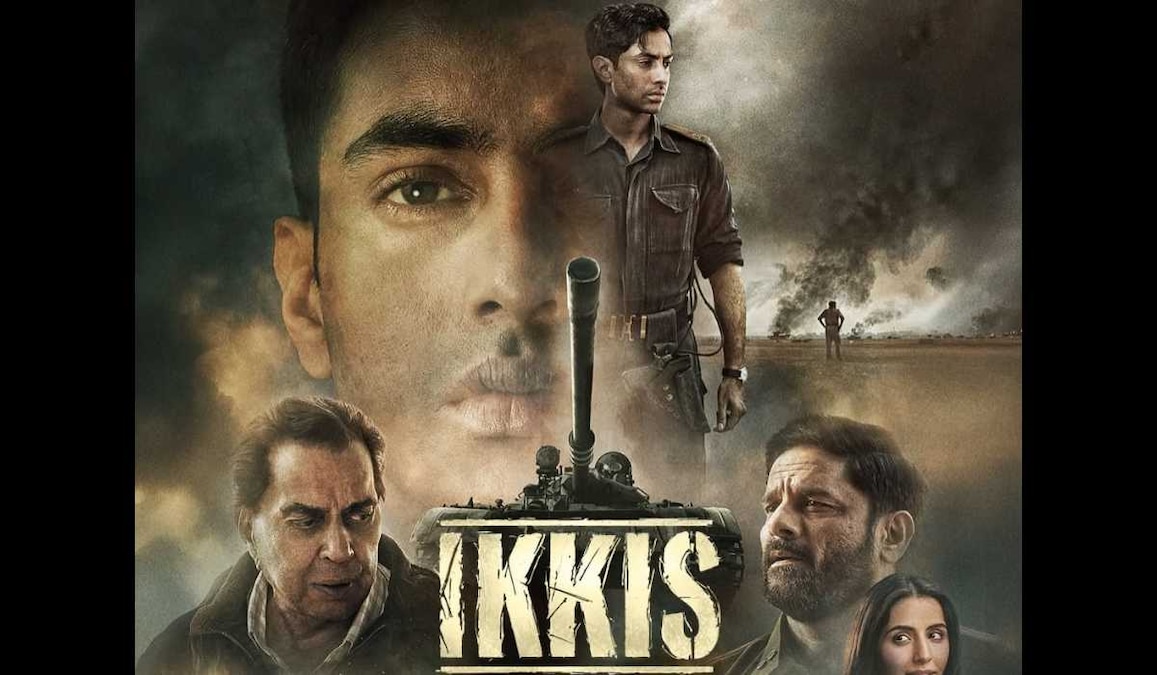
Ikkis poster
Ikkis story:
The biographical war drama Ikkis by Sriram Raghavan details the remarkable life and bravery of Second Lieutenant Arun Khetarpal, the youngest Indian to receive the Param Vir Chakra. The film, which takes place mostly in 1971 during the Indo-Pakistan War, depicts the life of a young officer (Agastya Nanda) as he goes from his time in military school to his now-famous stand at the Battle of Basantar.
Experience the evolution of Sriram Raghavan’s suspenseful storytelling by streaming his gritty revenge masterpiece Badlapur alongside his early directorial gems in the Star Bestsellers anthology, both available now on OTTplay Premium.
While the film captures the intensity of brutal tank battles, the narrative seamlessly weaves between two timelines. In one, we follow young Arun's mission; in the other, set years later, we see his father, veteran Brigadier M.L. Khetarpal (Dharmendra), travelling to Pakistan to meet the retired officer (Jaideep Ahlawat) who once faced his son on the battlefield. The film beautifully portrays the profound moments of bravery and vulnerability that defined Khetarpal's final mission, paying homage to the sacrifices of young warriors and the unbreakable bond shared by generations of soldiers.
Ikkis review:
When was the last time you saw Pakistan portrayed in a Bollywood film through a lens other than hatred? While Raazi touched upon this, one would generally have to go back two decades to Veer-Zaara to find such a humanistic approach. Given the current cinematic landscape, Ikkis is a tremendous surprise. Set against the backdrop of the 1971 war, it is perhaps the most profound anti-war film I have seen in years. Sriram Raghavan has taken a legendary chapter of Indian history and highlighted its modern relevance, pointedly avoiding the path of jingoism that has become the industry norm.
The film opens with an intriguing title card displayed in a sort of electric crimson—a visual cue very similar to the "noir" vibes of Raghavan’s previous works (Andhadhun Badlapur). This initial aesthetic creates the impression of a gory, high-octane war film. However, the narrative unexpectedly shifts into a sombre, reflective tone almost immediately. Raghavan avoids a linear structure; the story jumps 30 years ahead from 1971 to 2001. In this timeline, we find Brigadier Khwaja Mohammed Naseer (Jaideep Ahlawat) in Pakistan. In a poignant scene, we witness him tidying his room, which also houses a framed photograph of the fallen Second Lieutenant Arun Khetarpal.
It is a striking image: a Pakistani army officer keeping a photo of an Indian officer in his private quarters. He removes the frame only because he has invited Arun’s father, retired Brigadier M.L. Khetarpal (Dharmendra), to his home. Even in these small moments, there is no lingering hatred—only a quiet, mutual respect and an eagerness to meet the man whose son he fought decades ago.
The 1970s segment plays out as a coming-of-age tale, though it is one we know concludes abruptly at the age of 21. Raghavan ensures we feel the weight of Arun’s journey from the National Defence Academy (NDA) to becoming the commander of the tank Famagusta. With a runtime of 147 minutes, the film takes its time. Interestingly, Raghavan chooses an uncomplicated route here; unlike his previous thrillers, there are no sudden plot twists, only the steady, inevitable march of history.
While the film is titled after Arun Khetarpal, it isn't strictly "just" his story. It explores his relationship with Kiran (Simar Bhatia) and his commitment to his country, but the true emotional anchor of the film is Dharmendra. While Agastya Nanda provides the film’s pulse, it is Dharmendra who provides its soul, elevating the emotional quotient to a different level.
There are countless moments where his ever-smiling face masks the deep-seated pain of a father who lost his son long ago, yet acknowledges that soldiers on both sides were simply doing their duty. There is a poignant moment where he notes that while he understands his national duty, no one knows when war will finally stop being the answer. Instead of indulging in jingoism, the film makes a powerful and quiet statement favouring humanity over hostility.
We see that Arun, always being inspired by the environment he had his formative years in, decided to be driven by a singular focus to prove himself on the battlefield. During his training period when he is chosen to serve in the war, he leaves no stone unturned in leaving an impressive mark on his seniors so as to not be in the reserve. There are so many scenes in the timeline where we see Arun being brash and not thinking about the adversities he might face in his personal life while making those national duty decisions. From ratting his fellow army trainees out to having his love life questioned, Arun does it all, and he believes that's what got him to become the tank commander. However, he also feels instant regret in those moments, and Raghavan, although it's a biopic, makes sure that's what can be expected from a 20-year-old.
Meanwhile, in the 2001 sequence, the film makes you feel intrigued about whether there's a hidden agenda in the meeting between Dharmendra and Ahlawat. The film keeps taking slight turns until it reaches the point where Naseer tells Brigadier Khetarpal who he really is while making sure that the latter's trip is memorable in a positive way.
If you ask me, Ahlawat ties the film so beautifully that although he is a catalyst in the story, there's not a single moment where he doesn't want you to look away from him. The actor is so absorbing, even in the flashback sequences of reaching this poles-apart persona in 2001, that he keeps you on the edge of your seat and makes you empathise with him. There's a scene where he talks about fighting war, in an interaction with Dharmendra's character, where he says "dushman" and stops himself immediately.
While the film bridges the gap between India and Pakistan with humanity, it's not hunky-dory throughout. The film also illustrates how the attacks occur out of hatred, but the soldiers who fulfil their duties understand that while following orders, they must also prioritise correctly. In one of the scenes, when the Pakistani army men are captured by the Indian army, one of the soldiers suggests killing them all. Vivaan Shah's character disagrees and suggests taking them as prisoners of war.
Raghavan shows the harsh realities of war with the screenplay he penned with Arijit Biswas and Pooja Ladha Surti. But that doesn't stop him from declaring that war has only incurred losses of life and property.
We are living in times where keyboard warriors on the Internet tell how the war should be fought and how "enemies" should be shot down. In an era of digital vitriol, Raghavan uses Ikkis to remind us of Gandhi’s sobering truth: that an eye for an eye ultimately makes the whole world blind.
The film's positive approach took time for me to come to terms with, because that's not what we have been seeing on the screen for a long time. But showing a sense of empathy in times of the continued hatred is what is needed right now!
Having Nanda in his debut theatrical release, the actor manages to hold his ground, and to be honest, it comes effortlessly, as in his segment, he is shown in every frame. The actor brings the necessary naivety to his character, along with the occasional bratty behaviour that emerges throughout the film.
On the other hand, having Dharmendra play this role of a brigadier is a perfect casting, I must say. The late actor shows the softness even when harsh realities are hit almost every time, bringing depth to his character and also to the film. The legendary actor had the best dialogues, which feel like he is breaking a fourth wall and telling the people watching him that hatred can never be the solution for anything in this world.
Having Ahlawat play as a not-so antagonist is beautiful and a visual treat. The actor adds depth to the film by undergoing a metamorphosis through his character. It felt like the character had been tailor-made for him.
Ikkis to be honest, is the right way to start the new year and probably comes as a resolution for choosing empathy over hate at any time.
Ikkis verdict:
Ikkis is a masterfully restrained war drama that bravely prioritises humanity over hostility. Sriram Raghavan manoeuvres away from modern jingoism, instead delivering a poignant meditation on mutual respect across borders. While Agastya Nanda captures the youthful pulse of Arun Khetarpal’s legacy, the seasoned performances by Dharmendra and Jaideep Ahlawat give the film its soulful depth.
Top 6 Jaideep Ahlawat Thrillers & Dramas
Share