Home » Reviews » Mandala Murders review: Vaani Kapoor enters the circle of fear, but the centre doesn’t hold
Mandala Murders review: Vaani Kapoor enters the circle of fear, but the centre doesn’t hold
Mandala Murders blends horror, history, and mystery with chilling ambition. Though flawed and slow-burning, its eerie intrigue and layered storytelling keep you hooked till the haunting end.
2.5/5
Jul 25, 2025
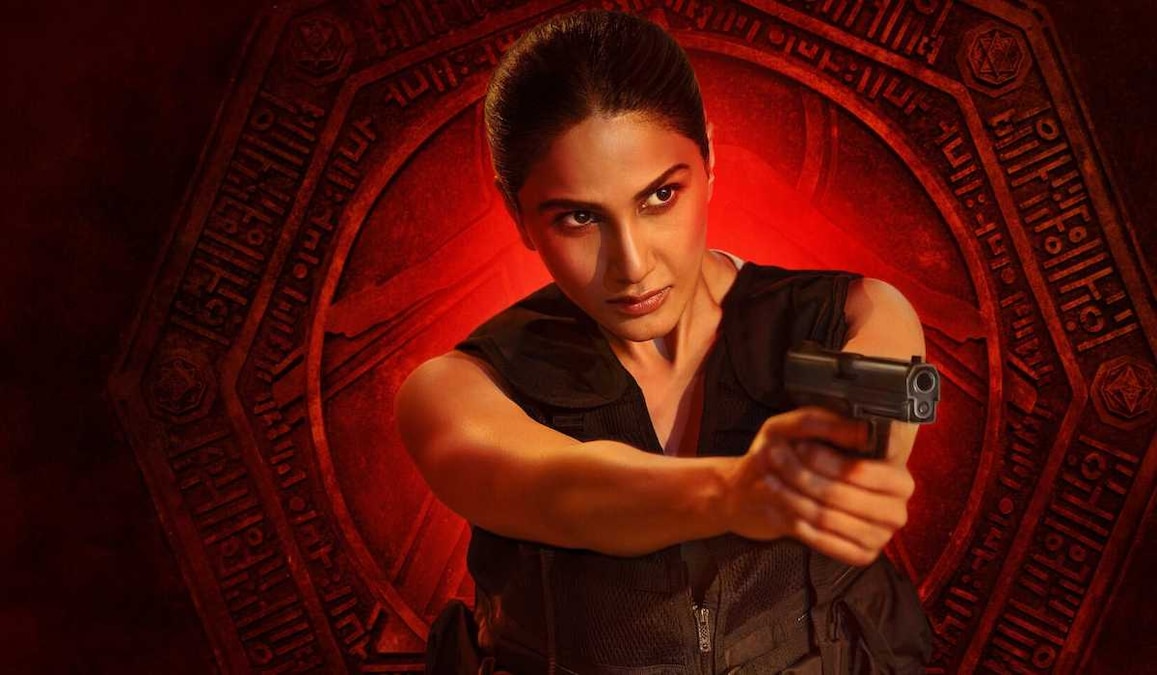
Vaani Kapoor in Mandala Murders
Mandala Murders story:
Detectives Rea Thomas (Vaani Kapoor) and Vikram Singh (Vaibhav Raj Gupta) uncover a spooky plot of ritualistic murders connected to a hidden society that has existed for centuries in the charming and enigmatic town of Charandaspur, where myth, murder, and destiny intertwine. In a chilling game of fate, the boundaries between victims, survivors, and those seeking the truth become hazy in a country of sinister prophecies.
Unravel gripping mysteries and twisted secrets with A Simple Murder, Crime Next Door, and 36 Days—now streaming on OTTplay Premium.
Mandala Murders review:
Imagine a scene where a man is taking a dip in the holy river, and just in time, a body floats by; the limbs are stitched to the face, and the torso is missing. That’s the setting and intriguing beginning of Mandala Murders. The series kicks off in 1952 in the most bizarre way, where a cult led by Rukmini (Shriya Pilgaonkar) uses a time-based machine that leads to the creation of a mutant-like being. The villagers decide to take charge and destroy the cult, successfully accomplishing their goal.
The series then fast-forwards to 2025, when protagonist Vikram Singh (Vaibhav Raj Gupta) returns to his hometown, Charandaspur, where both his past and present are cloaked in darkness. Mandala Murders takes its time to unfold, spanning nearly six episodes before the plot begins to come together. A series of murders begins in the town with Vikram’s return. As a Delhi Police officer, he quickly slips into work mode and becomes entangled in unimaginable situations.
While watching the series, I realised that the horrific elements serve a purpose beyond mere shock—they’re a core part of the narrative. I'm not a fan of the horror genre, and I did get scared initially, as it veers into supernatural territory. However, the show becomes increasingly captivating as it expands beyond what it initially appears to be. Mandala Murders ensures the eight episodes aren’t just fillers, finding momentum in the first half and again in the finale.
The narrative draws a consistent connection to the series' origin, taking us back to 1952. Each episode opens with a time jump, spanning nearly every decade from the 1950s to the present. One constant remains: the cult’s intent to instill fear among the people of Charandaspur.
In nearly every episode, Saurabh Dubey appears as one of the cult’s executioners, offering a “vardaan” to those who seek help. Most plead to save a loved one’s life. To receive the blessing, they insert a coin in the machine and sacrifice their thumb. The miracle works—and soon, many others follow suit.
But every miracle comes at a price. Each wish fulfilled is followed by a murder—gruesome, disturbing, and increasingly grotesque, with one part of the body removed from every victim. The visuals grow more unsettling as corpses continue to pile up.
By the end of the first episode, Rea Thomas (Vaani Kapoor), an officer with the CIB, arrives in Charandaspur to investigate. She immerses herself in the unfolding crimes and quickly begins connecting the victims.
That’s about all I can reveal without spoiling the plot. Even if I did, the show is layered enough that explaining it all would still feel opaque, as much of the unpacking happens slowly and deliberately.
Creator and co-director Gopi Puthran, alongside Manan Rawat, ensures the screen remains engaging throughout. Puthran, who was previously impressed with Mardaani 2 continues to deliver compelling storytelling here.
While the plot often leaves you questioning its direction, the main characters follow a fairly standard arc with limited development. Vaani Kapoor’s Rea is a strong-headed officer, but her trauma occasionally throws her off course. The case serves as her opportunity for career redemption, yet this is the extent of her arc. Vaibhav Raj Gupta’s Vikram, meanwhile, is a man deeply tied to the events in town, and his life in Delhi also spirals because of the woman he loves. Surveen Chawla plays a politician and femme fatale whose morally ambiguous choices mirror roles she’s played before.
The series has several loopholes that become increasingly apparent as the narrative progresses. In the supernatural context, many elements defy logic, making you question the rationale behind several events.
Mandala Murders walks a tightrope between trying to entertain and exposing its own flaws. It takes time to pull you in and reveals how the cult is far more powerful than expected. To justify the ultimate purpose behind the killings, the murders continue unchecked, with the officers failing their mission at every step.
It constantly reminded me that, even though the saviour complex exists, it doesn’t always translate into execution. For example, Abhishek Bachchan's character in the Dhoom series asserts that one can only apprehend a thief in the act of committing the crime. But here, no such moment arrives until the very end—when you, just like Rea Thomas, finally piece together who the cult’s mastermind is in 2025.
The stereotypical character arcs limit the actors' performance opportunities. It’s like they’ve been boxed into roles with no space to stretch or surprise. Vaani Kapoor, in her full-fledged web series debut, headlines as the lead investigator. But there’s barely any main character energy in her performance—she gets few moments to stand out.
On the other hand, Vaibhav Raj Gupta breaks free from his Gullak image and gets into the angry young cop mode. Still, he ends up as a victim—both as a character and as a performer—trying hard to fit a mould he never quite owns. Yet, he emerges as the most impressive of the lot.
Surveen Chawla feels trapped in the same femme fatale space she’s played before—trying to justify morally grey decisions while never really surprising us.
Shriya Pilgaonkar appears in an extended cameo in the first and final episodes, returning us to the germ of the idea, where everything begins. She sheds her image of the girl next door to portray Rukmini, a woman who is both educated and deeply ingrained in the belief that humans can create mythological power beyond scientific understanding.
Mandala Murders is so densely packed that, by the end, you almost feel claustrophobic, barely able to adjust to its gradual pace. The conclusion becomes so inevitable that all you can do is mutter “Oh...” And that's all I had, too.
Mandala Murders verdict:
While Mandala Murders stitches together horror and history with atmospheric flair, it often loses itself in the fog of its own ambition. Despite its muddled maze of characters, the eerie intrigue keeps you circling till the end.
Best of Shriya Pilgaonkar on OTT
Share