Home » Sports news » Asia Cup 2025 Wrap: After Eventful India vs Pakistan Final, It's Time For A Reality Check
Asia Cup 2025 Wrap: After Eventful India vs Pakistan Final, It's Time For A Reality Check
<strong>Karan Pradhan</strong> breaks down India’s ninth Asia Cup crown, Pakistan’s collapse, and the key talking points from a tournament of hype, experimentation and uneven cricket.
Team OTTplay
Sep 29, 2025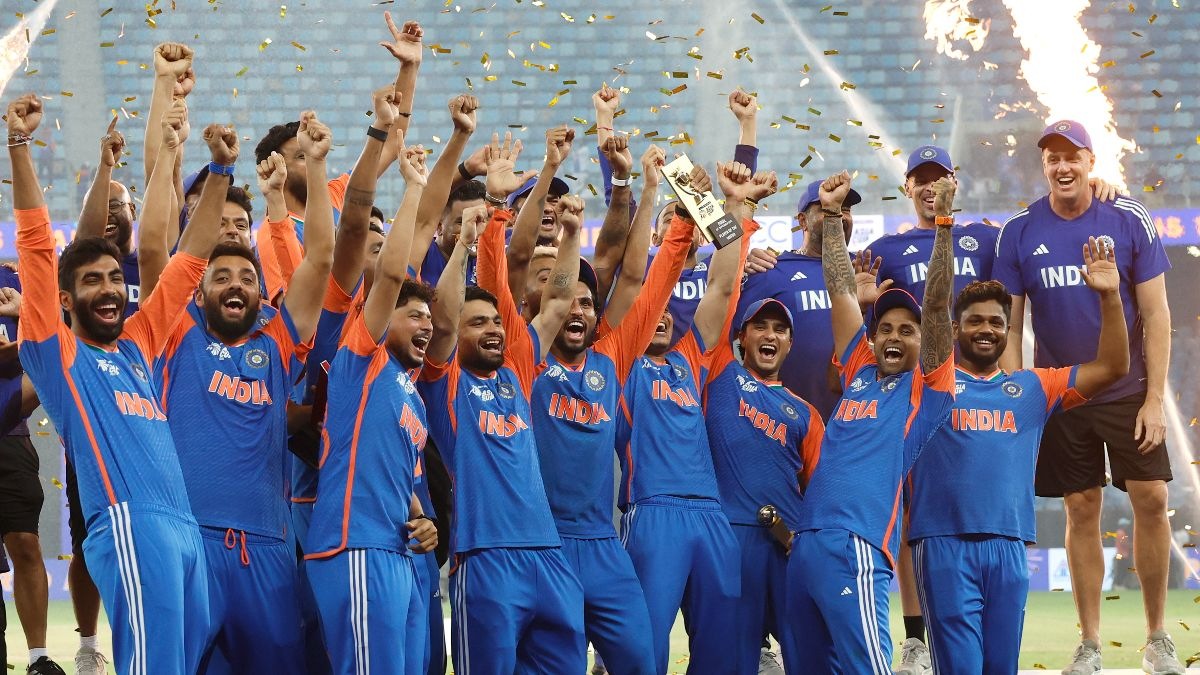
India dominated the tournament and went unbeaten through its three stages at the ACC Asia Cup 2025. Image courtesy BCCI
A FIVE-WICKET WIN in what was the first ever India-Pakistan Asia Cup final handed Suryakumar Yadav’s team their ninth title overall and second in the T20 format. Following a blazing start by their openers, Sahibzada Farhan and Fakhar Zaman, Pakistan lost nine wickets for a mere 33 runs. Having shambled their way to 146 all out, the rest of the proceedings seemed like a mere formality, but Salman Agha’s side had a trick or two up their sleeve. Here’s a quick look at five major talking points from the 17th edition of the Asia Cup:
The final
For a while, Farhan’s 57 and Zaman’s 46 threatened to turn into Pakistan’s best batting effort of the tournament. Their previous best had been 171/5 in the Super 4s match against India, and then too, Farhan had been responsible for laying the foundation with a brisk half-century. Unfortunately for Pakistan this time, no batter from No 4 onwards could even breach the double-figure mark. And this had as much to do with the effectiveness of spinners Varun Chakravarthy, Axar Patel and Kuldeep Yadav as the impatience of the batters. The agricultural heave that led to Hussain Talat’s downfall is a case in point.
Missed the match everyone's talking about? Catch the replay!
Chasing a target of 147, India’s explosive opener Abhishek Sharma wandered down the track and swished at the first ball. He’d become somewhat accustomed to starting things off with a big hit and probably imagined that was going to par for the course. Twenty-three balls later, Sharma, Shubman Gill and skipper Suryakumar were back in the pavilion with only 20 on the board. For the first time in a long time, Pakistan seemed in control of a match against India. But it would not last. Aided by sloppy fielding and an inexplicable insistence on handing the profligate Haris Rauf the slog overs, Tilak Varma, Sanju Samson and Shivam Dube steered India to an ultimately comfortable win. The small consolation for Agha and his men was that it was the first time all Asia Cup long that they were actually competitive against this opposition.
A dearth of quality
The last three matches of the 2025 T20 Asia Cup did something the first 16 barely could: Keep things interesting. Since beating Pakistan for the very first time in the 1999 World Cup, Bangladesh have defeated them only nine times in white ball cricket (ODI and T20I). This was shaping up to be the 10th, before an inspired Shaheen Shah Afridi stopped them an agonising 11 runs short. The final match of the Super 4s saw India and Sri Lanka play out an ultimately lopsided Super Over, but everything that preceded it was exciting, high-scoring T20 cricket at its (near) best. And then there was Sunday’s final.
India dominated the tournament and went unbeaten through its three stages. A part of this is down to the effectiveness of their top order batters and spin bowlers, but it’s equally true that the Test-playing nations seem to be in scratchy form or in some sort of a transitional phase in their respective journeys. Pakistan are adjusting to life under new coach Mike Hesson (appointed in May this year), Sri Lanka haven’t been the same since their big guns retired and political wrangling became more overt (something that led to Sri Lanka Cricket’s brief suspension in 2023). And Bangladesh are adjusting to life without the likes of Shakib Al Hasan, Tamim Iqbal and Mushfiqur Rahim. But, professional sport is usually unforgiving and quite blind to these concerns. Hearteningly for Asian cricket, however, is the rise of the Nepal national team, who stunned the once-mighty West Indies in nearby Sharjah last week. Perhaps they’ll feature in the next Asia Cup.
Tailor-made formats
The Super Sixes (or intermediate stage) was first introduced in multilateral tournaments during the aforementioned 1999 World Cup. The purpose was dualfold: To make points accrued in the group stage count for something, and to allow the best teams from both preliminary groups to play each other. In 2007, this would be expanded to a Super Eights format. Flash-forward to 2025 and the Asia Cup Super 4s perform an additional function: To cram yet another India-Pakistan match into the fixture list. It’s unlikely to have missed anyone’s attention that ever since the suspension of bilateral cricket engagements in 2008 (a short T20 and ODI tour in 2012 notwithstanding), massive efforts have gone into ensuring that every multilateral cricket tournament features at least one match between these two teams. Contrived, sure. Convenient, definitely. A money-spinner, you bet!
That’s why it came as no surprise to see the two teams drawn in the same group. In fact, you’d have to go back as far as the 2011 World Cup to find the last instance of a major tournament that didn’t see India and Pakistan in the same group. It’s no exaggeration to point out that no other rivalry has received this sort of service. But then, the tournament planners took it a step further to ensure the duo would meet again in the Super 4s, and if all went to plan, a third time in the final. Playing out a three-match triseries under the aegis of a regional tournament is a whole new level, and while the monetary gains are significant in the short term, what happens when people get bored of more and more of the same?
Bench strength
Aside from the thumping wins, the unbeaten streak and the tournament championship, one of the biggest gains for India from the Asia Cup was a good look at its bench strength. Leaving the likes of Yashasvi Jaiswal, Prasidh Krishna, Washington Sundar, Riyan Parag and Shreyas Iyer back home went a long way in demonstrating the pool of high-quality players the BCCI has at its disposal. The ability to rest Jasprit Bumrah and weather the injury to Hardik Pandya in the final underlined the depth of India’s T20 bench strength.
But it wasn’t just in the overall selection that the bench demonstrated its might. Suryakumar was extremely flexible with his batting and bowling orders throughout the tournament, and it seemed like he was intent on giving everyone a chance to prove their worth. And fortunately for him and India, most stepped up and took their opportunities. This augurs extremely well for the team considering there’s a T20 World Cup coming up in under six months.
A need for consistency
There was a fervent hope that the histrionics that occurred after the India-Pakistan group stage match would be a one-off. That the message — whatever it may have been — had been delivered and sport would be allowed to take the driver’s seat. After all, the multilateral meet for politicians was taking place around 11,000 miles away at the UN in New York City. Citizens of eight nations had gathered in the UAE for what was, by all accounts, meant to be a multilateral sports meet. That hope was dashed when the politicking and posturing dragged on into the Super 4s match. While one side stuck to its ‘no handshakes’ motto, the other was busy turning gunfire and aircraft gestures into celebrations.
And on Sunday night, the situation deteriorated when a farcical post-match presentation saw no one receiving the apparently-not-so-coveted Asia Cup from ACC chief Mohsin Naqvi. And to make matters worse, the final had been a pretty good game of cricket. Not wishing to dwell too much on this point, let’s leave it at the following. Either sports and politics are inextricably intertwined, in which case no sporting engagement (whether bilateral or multilateral) should take place. Or, the two are treated as separate entities and given the place and accord they each deserve. What we have instead is a crass display in which sport and politics are being sacrificed at the altar of soulless capitalism — a half-and-half approach that doesn’t augur very well for anyone. Well, anyone except the advertisers and boards, that is.
Karan Pradhan is editor-in-chief of Story Mode a gaming and gaming-adjacent magazine. Follow him on X/Twitter @karanpradhan_
Watch the highlights from the rousing India vs Pakistan Final of the ACC Asia Cup 2025, on OTTPlay.
Share