


OTTplay At Berlinale 2026: Madhusree Dutta's Flying Tigers & Assam's Forgotten War
Meenakshi Shedde reviews Flying Tigers, Madhusree Dutta's Berlinale-premiered documentary, which unearths Assam's forgotten role in WWII — and the story of 5,000 silenced mules who went to war.
Last Updated: 08.40 PM, Mar 18, 2026
This review is part of award-winning film critic, journalist and curator Meenakshi Shedde's dispatches from the 2026 Berlin Film Festival for OTTplay.
***
MADHUSREE DUTTA — senior filmmaker, curator, activist, cultural expert, author and visionary, living between India and Germany — had a warm reception to her expansive documentary feature, Flying Tigers, at the Berlin Film Festival in February 2026. This is a comeback of sorts for Dutta, who has returned to directing films after 20 years; Flying Tigers played in the Forum section of the festival (meant for more experimental films).
A two-time National Award-winning filmmaker, Dutta’s films include I Live In Behrampada, Memories Of Fear, From Here To Here (co-directed by Philip Scheffner), and 7 Islands And A Metro (2006), that even had a theatrical release. Dutta has a unique profile among Indian documentary makers: in addition to directing eight films, she was founder-director of Majlis, a centre for interdisciplinary arts in Mumbai (1998-2016), and artistic director of the Academy of the Arts of the World (Akademie der Künste der Welt) in Cologne, Germany, 2018-2021. Her previous work shown at the Berlinale includes Cinema City, a large multimedia project she initiated, comprising many shorts exploring the relationship between urban spaces and cinema, that was in the Forum Expanded in 2010. She was also on the Berlinale’s International Short Film Jury in 2015.
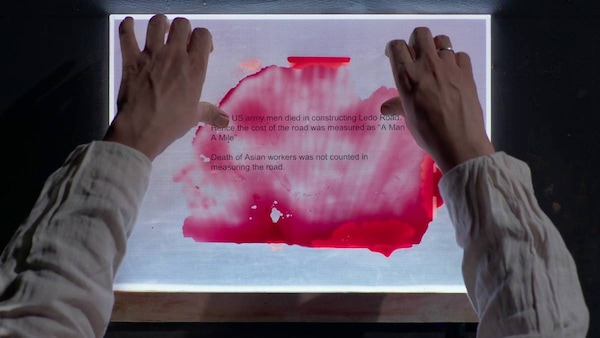
Flying Tigers starts with Dutta’s Alzheimer’s-afflicted mother’s fear about tigers invading their home in Mumbai, following which the director travels to Assam to explore the possible origin of that fear. Teaming up with researcher Purav Goswami in Assam, she stumbles upon the Flying Tigers: US military aircraft that transferred supplies during World War II across the Himalayas, from Assam to Kunming in China, to support the war effort against the Japanese. This gigantic exercise — of which the general Indian public is not widely aware — was of such a scale, that tigers living in the forests of Assam fled into human settlements, possibly leading to Dutta’s mother’s memory of tigers invading their house.
From this discovery, Dutta’s documentary-essay expands into larger issues, including war, infrastructure, as well as the fluid nature or memory, national borders, and indeed, the borders between documentary and fiction. In doing so, typically, Dutta’s film also absorbs from other disciplines — art, poetry, history, animation, music and more. Dutta’s film also links to Sourav Sarangi’s documentary Char: The No Man’s Island, that was shown in the Berlinale Forum in 2013, that also explored the fluidity of national borders (char are islands formed by silt in the middle of rivers, that appear and disappear), and Ritu Sarin and Tenzing Sonam’s multimedia exhibition Shadow Circus, on the role of the CIA in Tibet, shown in the Forum Expanded in 2019.
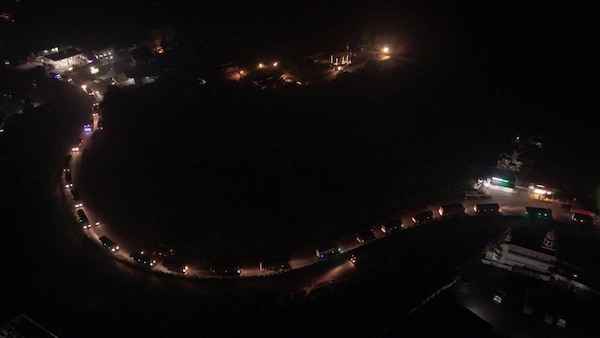
It is ironic, Dutta told me in an interview, how little people-to-people contact Indians have with the Chinese, our immediate neighbours, apart from the Chinese diaspora populations living in India. But in Germany, she meets Kunming-born Chinese media theorist Mi You, and discovers that her family and community were affected by the Flying Tigers in Kunming, on the Chinese side of the Himalayas. The coincidence prompts Dutta to investigate further, and she contrasts the smooth international flow of goods today — thanks to aggressive capitalism — with the increasing restrictions on the movements of people across borders.
We learn altogether fascinating details concerning the Flying Tigers: like plane doors being used as pig’s feeding troughs in Assam. Or of 5,000 mules — medically de-vocalised in the US so their braying wouldn’t alert the enemy — sent from US ports to Calcutta by ship, then to Assam by rail, then to Kunming by flight for the US’ China-Burma-India “CBI” operations; info gleaned from the American Mule Museum (wow!) — a typical, mind-boggling Dutta gem! And of course Dutta is constantly responding to current events; in Assam, she creates an installation of sorts — a table under a ramshackle umbrella by the river — with a recitation of haunting Miya poetry: “This is my country…I don’t belong to this land…” Thereby she comments on how the National Register of Citizenship (NRC) is an attempt to deny mostly minorities of their nationhood by demanding papers that are not always available to migrant populations on unstable islands.

Dutta’s direction is assured — she is a veteran in connecting sweeping ideas and joining the dots across geographies, histories and eras. Her approach in her screenplay is also more meandering like a river, led by history, anecdotes and memory. In a rare exception, she appears in the film herself. The cinematography by Riju Das (All That Breathes), Isabelle Casez and Guligo Jia Yanan allows us to connect with the people and places, even when we see that it is a set-up. Federico Neri’s editing connects big ideas, but we are sometimes overwhelmed by the jump cuts and sheer amount of information, multiple issues and timelines in 105 minutes. The children’s song and ‘Infrastructure’ song don’t quite work, but that's a minor quibble.
The women crew include director-writer Madhusree Dutta; producer Alexandra Gerbaulet and Merle Kroeger of Pong Films; coproducer Tarshia Dutta of TCG Studios; Mumbai, cinematographers Isabelle Casez and Guligo Jia Yanan; protagonists Dutta, Mi You and Devika Hazarika; Nina Sabnani’s animation; and dramaturgy by Merle Kroger and Bina Paul. Berlin-based Visionaer Films came onboard for sales even before its Berlin premiere. We hope the film will be screened widely, including in India.
***
Meenakshi Shedde (Facebook | Instagram) is a National Award-winning film critic, journalist, curator and global influencer, shaping opinions on South Asian cinema worldwide since 40 years, based in Mumbai. She has been curator/programmer to TIFF Toronto, Berlin and film festivals worldwide. She has been jury member of 25 film festivals, such as Cannes, Berlin and Venice, including the jury of Cannes’ Semaine de la Critique (Critics’ Week) 2023, and was also Golden Globes international voter.