


Victoria: About Womanhood, Wounds & Quiet Resistance
Victoria gently peels back the layers of a young woman’s life, set against the backdrop of a modest salon that becomes a silent witness to fractured dreams, shared sisterhood, and subdued rebellion.

Still from Victoria
Last Updated: 08.10 PM, Nov 28, 2025
HOW FITTING THAT A BEAUTY PARLOUR — traditionally seen as a space for surface-level transformation — would become the ideal site for women to slowly unravel their burdens, vulnerabilities, and quiet acts of resilience. In Sivaranjini’s 84-minute film Victoria, this modest parlour in a sleepy Kerala town becomes more than a workplace; it’s a holding space for silent endurance, where conversations are hushed, glances are loaded, and the looming weight of patriarchy is ever-present, despite the near-complete absence of men on screen.
At the centre of it all is Victoria, a young woman (a superb Meenakshi Jayan) who works at the parlour. From the outset, it’s clear that her role is underpaid and undervalued. She is expected to manage the establishment almost single-handedly, juggling multiple responsibilities with little structural and emotional support. The parlour itself reflects her condition — barely maintained, with minimal tools and resources, and functions on neglect and quiet efficiency.
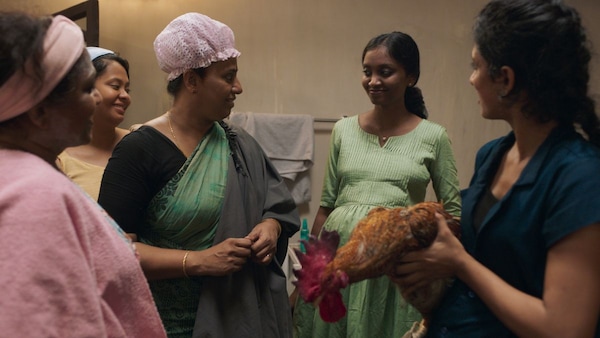
Victoria isn’t a fiery rebel or an archetypal victim, but her silence, passivity, and internalised submission speak volumes. She can rarely assert herself and seems conditioned to accommodate others' needs (however absurd that is). This is exemplified when her neighbour makes an outlandish request to leave a rooster in the parlour. What might initially seem like a surreal, even comical intrusion slowly morphs into something more symbolic. The rooster struts awkwardly among the women and mirrors the absurdity of Victoria’s situation — an out-of-place creature in a hyper-feminine space, tolerated without question.
Perhaps the rooster might not serve any specific metaphor, but it sure does unsettle the visual and emotional rhythm of the parlour. The creature draws attention to the imbalance in Victoria’s world, where boundaries are blurred, and where she is denied even the smallest control over her environment. It becomes a curious spectator to the everyday interactions among the women — a silent witness, much like Victoria herself.
Even in her relationship with her lover, Victoria often feels unheard and subtly coerced. Having been caught between a father who controls her income and a lover who takes her for granted, she is navigating a relentless struggle with choice, faith, and familial expectations and is also frequently compelled to comply with patriarchy in its many forms.
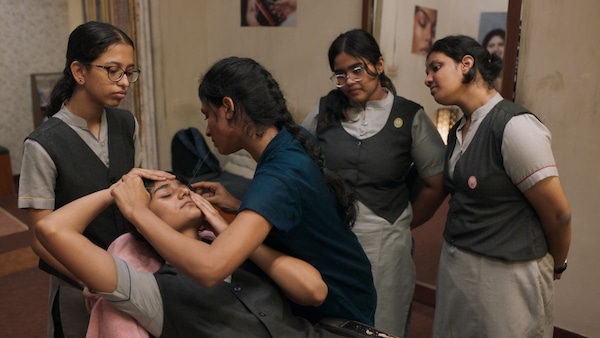
The customers who pass through the parlour add depth to Victoria, each carrying stories that subtly reflect the world they inhabit. These women, from all walks of life, are there not just to beautify themselves, but also to momentarily unburden. Take, for instance, this woman whose father-in-law is in intensive care. She has slipped away for a quick facial, justifying it by citing an upcoming wedding she must attend. Though one cannot rule out the humour, what it tells, though, is something more poignant, about the burden of having to constantly balance duty and self-preservation for women. Another customer, a daily-wage labourer, seeks a beauty treatment not out of vanity but as a brief escape from the grime, sweat, and invisibility of her hard, physical labour. Then there’s a middle-aged woman who hesitantly enters the parlour, trying to make sense of what is her first visit — unsure, tentative, yet seeking something intangible in the gesture of self-care. In one particularly telling moment, Victoria is seen advising the lady against colouring her hair, gently noting that she has only a few grey strands. It’s a rare, subtle glimpse into Victoria’s quiet integrity — her refusal to push unnecessary services. But that small act of honesty is quickly undercut by her boss, who warns her against such transparency. It’s a reminder that even in seemingly safe, women-only spaces, the demands of commerce — and the implicit values of a beauty industry that thrives on women’s insecurities — are never too far behind. Conversations, though casual, lay bare the patriarchal structures they live under — choices around clothes, marriage, or financial dependence are never truly theirs. There is a lovely passage that features two women on either side of a thin curtain, talking freely about family and inherited patriarchy, their voices weaving a quiet tapestry of shared struggle.
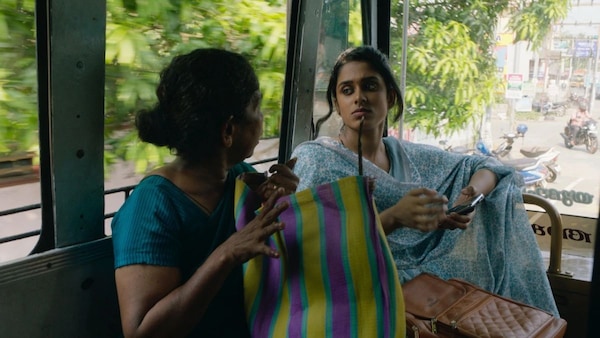
One of the most stirring depictions of female solidarity in the narrative emerges when Victoria’s former classmate, now visibly pregnant, visits the parlour for a pedicure. As they catch up, the conversation moves beyond pleasantries, hinting at the silent battles each woman is fighting. Victoria, still hesitant to disclose the complexities of her romantic entanglement, listens as her friend subtly reveals the emotional void in her marriage and the financial control she endures. The exchange is laced with unspoken pain and mutual understanding. For a brief moment, Victoria’s composure falters — her burden surfacing in a rare crack of vulnerability. While not a dramatic turning point, it ends up as a gentle, significant nudge toward clarity, thereby contributing to Victoria’s growing awareness of her entrapment and the possibility of change.
Interestingly, the film’s slow pace, almost languid, mirrors Victoria’s stasis. The frames are staged with intimate precision, capturing the unspoken emotional currents between characters. Each shot reflects a keen understanding of their inner world, their hesitations, longings, and quiet grief. Though the parlour is a modest, enclosed space, it transforms into a sanctuary of shared silences and compassionate glances. It is within this unassuming setting that some of the most emotionally resonant moments unfold, making the parlour not just a workplace, but a space of quiet solidarity and reflection.