Home » Features » Ordinary Men, Extraordinary Darkness: Malayalam Cinema’s Most Disturbing Psychopaths
Features

Ordinary Men, Extraordinary Darkness: Malayalam Cinema’s Most Disturbing Psychopaths

From Stanley Das’s icy detachment to Joji’s simmering resentment, from Raghavan’s deceptive calm to Jayarajan’s calculated ambition, we've seen how ordinary men can spiral into monsters.

Neelima+Menon
Dec 18, 2025

What makes them unforgettable is not their brutality, but how frighteningly believable they are.

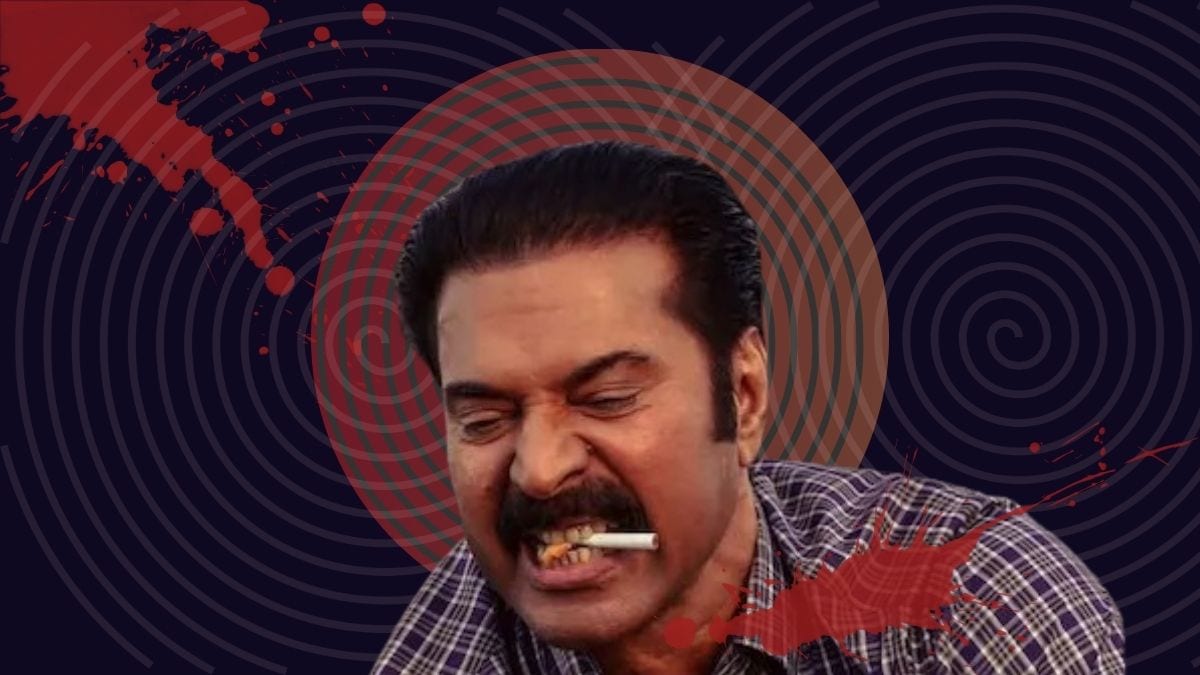
THERE'S A CHILLING almost innocent façade with which Stanley Davis (Mammootty) approaches his victims. Early in the film, we see this calm, soft-spoken man step out of his cosy family bubble to woo young and middle-aged women with a charm built on quiet precision. Take the first encounter in the car, where he casts careful, sideways glances at the young woman, placing his hand over hers with a tenderness that subtly twists the illusion of romance, making it almost impossible to doubt. But later, in the hotel room, that same softness curdles. And that space still warm with the haze of lovemaking becomes, almost imperceptibly, the stage for a meticulously executed murder. With neither theatrics nor raised voice, you witness his seamless, practised shift from lover to predator. In another instance, he is speaking to a young woman with quiet ease, gently coaxing her into spending the night at a hotel. When she admits that she knows exactly what the invitation implies, Stanley responds with an almost disarming tenderness, never pushy, never overtly suggestive, but just enough to create the impression that she is the one steering the moment, the one choosing for both of them.Kalamkaval directed by debutant Jithin K Jose and co-written with Jishnu Sreekumar, orbits around this smooth-talking psychopath who seduces women, impregnates them, and murders them with a cold, methodical persistence that is unnerving to witness. What makes this character especially disturbing are two deliberate creative choices: a) he is portrayed by a matinee idol who has long been associated with on-screen heroism, thereby creating a jarring dissonance between star image and monstrosity, and b) the film withholds any attempt at a backstory or a psychological justification, refusing to romanticise, explain, or glamorise his violence.

Stream the latest Malayalam, Tamil, Telugu and Kannada releases, with OTTplay Premium's Power Play monthly pack, for only Rs 149.

And Stanley’s duality becomes terrifying the moment his paper-thin façade of charm peels away, exposing the icy precision underneath. Once that soft smile drains from his face, a stillness seems to settle into his body, and suddenly you’re staring at a man capable of unimaginable coldness. As he seizes his victim, blank-eyed and deliberate, he grinds his cigar with a slow, deliberate cruelty, chews it like ritual, and spits it out precisely as the deed reaches its cold, inevitable end. That’s the moment when you realise that the charm was never a disguise but merely the silence before the storm.Even in the moment when he realises that the game is over, his first instinct isn’t remorse or panic but a deep, reptilian instinct to erase whatever stands in his way. His mind doesn’t even pause or recalibrate but simply moves to the next logical step, which is to remove the obstruction and resume the hunt. Kalamkaval OTT partner revealed! Here's where to watch Mammootty-Vinayakan's thriller online post-theatrical run
If Stanley is a psychopathic killer, Shammi (Fahadh Faasil) in Kumbalangi Nights (2019) is his caricatured cousin, a man who, like Stanley, hides behind the charm and manipulation but lets his toxicity simmer just beneath the surface. Within minutes of meeting him, you feel that uneasy prickle of being watched, measured, judged. It’s as if the only thing restraining him from unleashing what lies underneath is the fragile armour of his societal image.His introduction says it all: Shammi standing before the mirror, admiring his reflection, whispering, “the complete man.” And he keeps up with his glossy exterior, it’s there in his patronising gentleness toward his new bride, or the easy way in which he wins over his naïve mother-in-law. But then you realise that he has saved his venom for his sister-in-law since she refuses to bow to his rigidity, and this threatens the world he has so carefully curated. ALSO FROM THE AUTHOR | The Curious Case Of Fahadh Faasil's Onscreen Relationships With Women As the narrative unfolds, Shammi starts to mutate in front of us, growing from a controlling narcissist to a full-blown psychopath who seems utterly incapable of feeling anything for anyone but himself. And layered into that pathology is a hardened misogynist, a casteist, a classist and someone whose worldview is shaped entirely by dominance and entitlement. Soon it becomes frighteningly clear that if he hadn’t been confronted and exposed, Shammi could have blossomed into an active threat to the very family he pretended so desperately to protect.
In sharp contrast, Panachel Joji (Fahadh Faasil) in Joji (2021) directed by Dileesh Pothan, is a frail, almost shrunken young man, dwarfed by his autocratic father and burly brothers who seem to dominate every inch of his life. In that expansive household steeped in hypermasculinity, where the only woman is confined to the kitchen, Joji is starved for visibility. So it’s hardly surprising that he gravitates towards the “gentler” forces in the family: his sister-in-law and his nephew. And even his attempts to assert “power” are almost comically performative. So he revels in fleeting, borrowed symbols of dominance, be it driving the family’s Jeep Compass, the misplaced pride in owning a horse, or the overzealous affection he showers on his nephew. These are not displays of power but fragile imitations of it.The film also hints at a childhood marked by loss, including his mother’s early absence and a life shaped by neglect, unrealistic expectations, and a suffocating fixation on money. Therefore, these elements become the film’s unsaid justification for Joji’s moral collapse. And soon enough, as the narrative unfolds, you witness a darker, more corrosive version of Joji, with his latent greed and bottled-up resentment spilling over, pushing him towards eliminating anyone who threatens his fragile sense of ascendancy. And, like Stanley Das, Joji remains essentially solitary, emotionally opaque and chillingly detached, even when confronted or exposed. His coldness is not an aberration, but the logical endpoint of a life spent on the margins of his own household.
In Venu’s Munnariyippu (2014) we are almost immediately disarmed by Raghavan (Mammootty), a soft-spoken, contemplative convict whose sparse philosophies carry an unsettling clarity. His reluctance to see his thoughts published, despite the journalist’s persistent urging, only deepens his aura of humility. Everything about him suggests a man at peace with himself: steady gaze, measured words, an almost ascetic detachment from the world. It is, therefore, easy, alarmingly so, to believe that he has been wrongfully convicted.As he sits across from us, musing casually about life, death, humanity, and perception, we can see a quiet brilliance in his worldview. His simplicity feels profound while his restraint almost seems noble. That’s why the film’s final twist detonates so violently. So when Raghavan’s wicked volte-face erupts in the climax, it doesn’t just shock but rearranges everything we thought we knew. Raghavan becomes, in that moment, a sinister echo of Stanley Das, not identical, but parallel: a psychopath equipped with a different set of tools and a different register of deception. Watch Mammootty's Munnariyippu here on Sun NXT, via your OTTplay Premium subscription. And in hindsight, his serenity sours. Every quiet observation begins to look like a concealed blade. Every pause feels loaded. Every smile feels like a rehearsal for something we failed to see. What seemed like clarity reveals itself as camouflage, and we are left confronting the most unnerving possibility of all: the real labyrinth was not the prison but his mind.
Three decades ago, in IV Sasi’s Uyarangalil (1984) MT Vasudevan Nair gave us PK Jayarajan (Mohanlal), a smooth-talking psychopath who never reveals what he’s actually thinking. His past is marked by being denied the life he wanted, having to go through humiliation, rejection, and the hard lesson that nothing comes without fighting for it. This shapes him into a bitter, calculating man who has no qualms about using women as pawns in his plans and discarding them once they become inconvenient.Unlike Stanley Das, who kills with a cold, habitual ease, Jayarajan’s violence is purposeful. For him, removing people is simply a way to clear his path to money and power. The drama lies not in the act, but in the cold arithmetic that precedes it. What makes Jayarajan truly arresting is the way he climbs, step by deliberate step, into a state of megalomania. So much so that he begins to imagine himself as a figure hovering just shy of divinity. Every move is premeditated, every word sharpened, every gesture meticulously curated. His exterior is carved from ice—calm, opaque, and unreadable. In crises, he sees openings; in threats, he sees opportunity. And not once does his façade slip.  In fact, watching him move through chaos without flinching feels like witnessing a man steadily rewriting the rules of power, one calculated betrayal at a time. Kalamkaval, Bha Bha Ba, and more... Here's a list of Malayalam theatrical releases in December
Share
return(
)