Home » Features » O'Romeo: Vishal Bhardwaj’s Bloody Tale Of Love Has No Heart
Features

O'Romeo: Vishal Bhardwaj’s Bloody Tale Of Love Has No Heart

Unlike other Bhardwaj films, which, almost always, hide yearning within pockets of brutality, O'Romeo unfolds as a love story suffused with blood, but the heart refuses to beat.

Ishita+Sengupta
Feb 14, 2026

Still from O'Romeo.

ALL FILMMAKERS plot legacy. For Vishal Bhardwaj, it filters to adaptations. The 60-year-old’s career — including 12 feature films in 24 years — is shaped, mostly, by taking literary texts and supplanting them in a world of his making. One can debate the merits, but there is something to be said about the tendency to assert his voice most intensely in borrowed words, thereby amplifying the collaborative spirit of creation. A chief collaborator, in this regard, has been Shakespeare, whose plays assume great malleability in the director’s hands. Bhardwaj’s latest, O'Romeo is not drawn from one of the playwright’s works but still culminates as an ineffective Shakespeare adaptation — a first from the director.

Stream the latest films and shows with OTTplay's Power Play monthly pack, for only Rs 149.
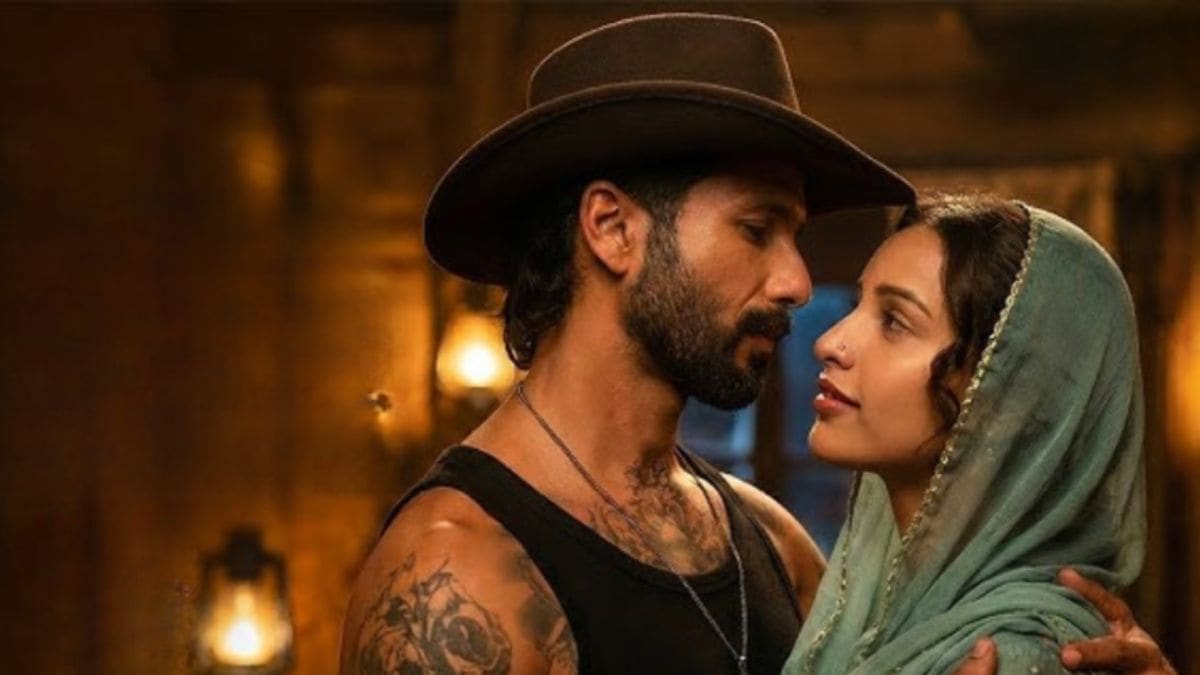
The connection is obtuse but inevitable. For one, the title, albeit abridged, is an ode to Romeo and Juliet. Bhardwaj, however, does something more defining. He designs his central male character after the heroes of Shakespeare’s tragedies, where a single flaw causes their undoing as they continue their descent to revenge. In this case, it is love.
Focusing on the man is a deviation from the main source but also reiterates the filmmaker’s intent of looking at the Bard for inspiration. O'Romeo is based on Hussain Zaidi’s book Mafia Queens of Mumbai (2011), which documented the story of Ashraf Khan, a key female figure in 90s’ Bombay crime scene who dedicated her life to avenge the death of her husband. To do so, she had allegedly planned an assassination of Dawood Ibrahim. According to Zaidi, Hussain Ustara, another dreaded gangster, had trained Ashraf and later fallen in love with her.Bhardwaj, who has written the screenplay with Rohan Narula (Zaidi is credited with the story), focuses on the man and his love. This invisibilises the woman to an extent, but what he loses with decentering, he tries to make up for it with yearning. O'Romeo is Bhardwaj’s take on swooning love that exalts and plummets but doesn't reciprocate. The kind that persuades and compels but refuses to abate. It enfolds an impossible pursuit, mandating violence as the language of the ache.This makes for a great alignment of the material with the maker. A Vishal Bhardwaj film can be many things, but it also, almost always, hides yearning within pockets of brutality. But O'Romeo translates as a great mismatch of tone and voice, unfolding as an instance of a love story suffused with blood, but the heart refuses to beat.
Such apathy is astonishing, not least because the filmmaker throws everything at the wall. O'Romeo marks Bhardwaj’s most affected filmmaking. Every scene and every frame bring attention to itself. The early minutes include a fight scene in a cinema hall as 'Dhak Dhak Karne Laga' plays on the big screen. It is Ustara (Shahid Kapoor) against a whole army of men. The actor dances a little, gets distracted a little by the song and then plunges into hacking those before him. Most of it is indelible — the choreography, Kapoor’s pliable moves, the light from the screen gathering around his silhouette — but the rendering is too Animal-coded, too steeped in the grammar of Sandeep Reddy Vanga’s 2023 film. Later, a visual of a character drenched in blood brings to mind another callback.Perhaps this distils the stillness of the love story in O'Romeo. The film is rooted in a post-Animal world, and the reckoning has tangible upshots. Violence is depicted not as an accompaniment to feelings but as a precursor to them. The discrepancy is so wide that every time a Gulzar song floats in the background, it appears to be resuscitating the characters and tugging at their unfeeling heart.
Set in 1995 Bombay (the year can be deduced through the many news items scattered across the film), O'Romeo revolves around Ustara (Kapoor), a gangster and police informer. He lives with his group of aides and grandmother (Farida Jalal). His reckless life is upturned the day Afsha Qureshi (Triptii Dimri) arrives in his room with a singular want: he has to kill the murderers of her husband. She offers him her jewellery, and he laughs at her face. Despite the initial refusal, sparks flow, but it's only Ustara who burns.Kapoor is an inconsistent actor, but his best works have come from his collaborations with Bhardwaj (Kaminey, Haider, and Rangoon). Ustara, a portrait of self-destruction and recklessness, is not an unusual ground for him. The character contains shades from his past portrayals (Kabir Singh’s rashness and Tommy Singh’s frenzy), yet the turn is too inward-looking. Selflessness, embedded in unrequited love, finds no footing in his performance that, much like the film, calls attention to itself. Ditto for other actors like Nana Patekar (plays Khan, the cop, who frequents the church). Dimri is effective as a woman tormented with guilt, and while her face makes suffering look tactile, it also makes for a recurring visual now. Shahid Kapoor calls O'Romeo 'special film' amid controversy; Says Vishal Bhardwaj brings out the best in him
There is an alluring dis-ease at the centre of O'Romeo where all the principal characters are sick with love. Bhardwaj posits the other branch of the story in Spain. Jalal (Avinash Tiwary), the main gangster pulling the strings in Bombay, lives there. His hands are bloody with the murder of Afsha’s husband. She wants to kill him, and Ustara, consumed by her, wants to kill him for her. In spite of revelling in gore, Jalal holds a torrid love for his wife (Tamannaah Bhatia).Such perverse malady comes closest to elevating Bhardwaj’s film. But O'Romeo, named after a man and worded as a hushed commiseration one reserves for men losing their bearings in love, is too eager to be seen than to see. Violence becomes its chosen weapon because severity, by definition, is also self-absorbed. In one scene, Ustara says, “main hoon ki hoon nahi”, reminiscent of Hamlet’s “To be, or not to be.” On paper, it is another nod to Shakespeare — a feverish plea from a fevered man. However, it translates to a tattooed gangster standing in front of the mirror. He is holding the woman he loves, but the one looking back at him is his own reflection. O'Romeo OTT partner revealed! Here's where to stream Shahid Kapoor-Triptii Dimri's action-thriller after its theatrical run
Watch more of Vishal Bhardwaj's work
Share
return(
)