Who Owns the Front Page? Rajinikanth & the Power of Tribute in Modern Media
Prof Sukaran Thakur unpacks Hindustan Times' Rajinikanth front-page tribute to explore how symbols, fandom and media power shape meaning in contemporary India.
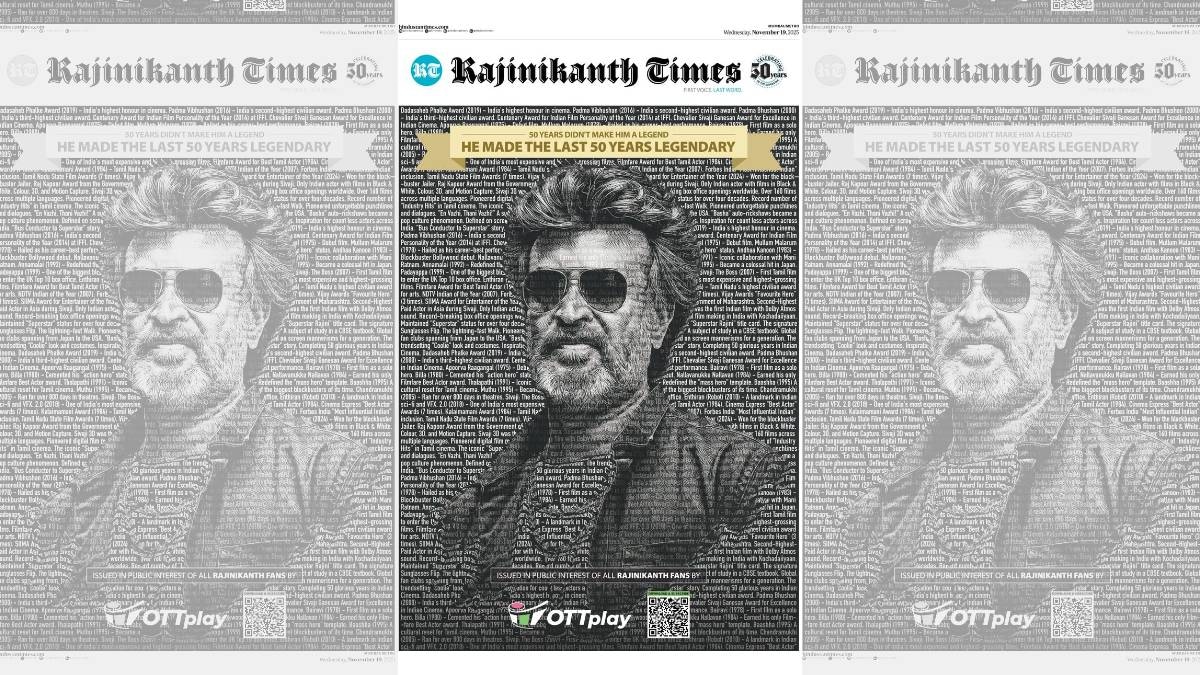
Rajinikanth Times: Hindustan Times x OTTplay dedicated a full front page, masthead included, to the Superstar on his completing 50 years in cinema.
EDITOR’S NOTE: As superstar Rajinikanth turns 75 today, it felt like the right moment to revisit a cultural gesture that unfolded just weeks ago — one that has continued to spark conversation inside and outside the media world.
On 19 November 2025, Hindustan Times, in partnership with OTTplay, reimagined its front page as Rajinikanth Times a one-day tribu te marking the actor’s 50 years in cinema. The takeover went beyond a branded moment; it was a rare instance of a legacy masthead bending, briefly, to honour a cultural force whose influence transcends geography, language and genre.
To understand what such a gesture signifies today — in an era of personalised feeds, algorithmic newsflows and vanishing print rituals — we invited media scholars to examine its deeper meaning.
In this essay, brand strategy, narrative design and semiotics professor Sukaran Thakur analyses what happens when the symbolic authority of the front page intersects with fandom, cultural identity and collective memory. Why did the Rajinikanth phenomenon become the perfect prism through which to read this moment? And what does it reveal about the evolving relationship between media, audiences and cultural icons?
Also read the companion column to this op-ed: Decoding a Front-Page Salaam to Superstar Rajinikanth.
***FLIPPING the pages of a newspaper is an ageing ritual; one mostly forgotten by the thumbs that are now more used to swiping than to turning. The diminishing attention spans, and a desire to indulge in AI-generated summaries as far as the eye can see has led many to prophesise, in a Nietzschean tone: “print is dead”. And yet, when a hundred-year-old newspaper bows down to a cultural tsunami, boldly allowing for a rename and a complete take over, one can’t help but question the very fabric of what the cultural significance of print is today. It’s a moment where the questions to be asked go deeper than discussing this act as a branding phenomenon but rather how this is a sociological event that pokes at the very nature of what is “the nation”, “the news” and “the tribute”.
ALSO READ | 50 Years of Superstar Rajinikanth: In the Beginning, There Was ShivajiA newspaper’s signature is its masthead, the unchanging ink that witnesses the present become history. For Hindustan Times, inaugurated by MK Gandhi, this masthead has seen the partition, the economic liberalisation, the arrival of the digital age, and in essence the very evolution of our story. With the fourth estate’s role in nurturing a democracy being the subject of many criticisms these days, a decision to allow a change in the masthead is often looked at with a suspicious eye. After all, if they are willing to sell their own name, then what else is for sale? So, when on the 19thof November, the morning ritual of unfolding the newspaper saw “Hindustan Times” transform into “Rajnikanth Times”, the semiotic violence of the change was absolute. As the eye scanned across the typographical art that adorned the front page celebrating 50 years of Rajnikanth’s presence in Indian Cinema, it becomes clearer that this is not the commercialisation, but rather the culturalisation of, a trusted voice. A voice that was attempting to hold up a mirror to the very fabric of the nation: that a cultural phenomenon can erupt in any part of this nation and continue to inspire and be owned across state-lines.Understanding this moment in media is essentially looking at three tectonic plates colliding into each other: the semiotic value of the front-page of print journalism, the psychology of people seeing themselves in their idols; and the fact that cultural moments are simultaneously created by and create the social identity of the people.Our memory of the world before everything was distilled into 140 characters or 30-second reels is one where the masses trusted the journalist with telling them what counted as important enough to be “front-page”. While homepages of digital-first publications get personalised and customised to each reader, the universality of the print’s first page loudly proclaims the idea of a unified social identity. It is this cultural memory that raises brows when we see a space normally reserved for informing us of all that’s wrong around the globe, occupied by anything else at all. And while the all-permeating ads that appear as “jackets” may create a layer before one accesses the real news; on the 19th of November, that wasn’t the case. The tribute and take-over of the front-page was absolute. One could not discard the “ad” without discarding the news. That act in itself is what turned the takeover into something that a branded piece could never be. The reader becomes the meaning-maker and in that moment began to contemplate, what truly is important enough for the front page?While Rajnikanth (and the story of Shivaji Rao Gaekwad) needs no introduction; the global outreach of a disarmingly fragile man is something that can stir intrigue. Ask a group of Gen-Zs about Rajni, and an unequivocal and unanimous “stylish!” still echoes today. There’s something deeply magnetic about seeing a man defy the stereotype of the chiselled, hyper-muscular heroes and still command an unparalleled fandom. Rajni’s story begins as that of an entertainer; while the quips of him entertaining the passengers of the bus where he earned his keep as a conductor before being discovered in the halls of the Madras Film Institute humanise him as an actor. It’s the audience’s embrace of a dark-skinned villain (an oddity in our colourist society) that made him something more. As the flipping cigarettes, immaculate style and narrative arc of the everyman who could break through glass ceilings permeated Tamil cinema, the actor turned into a phenomenon, the Thalaivar. People saw and still see themselves in the towering presence on screen. The self-deprecatory humour, the decision to not use makeup or a wig off-screen, and a desire to reinvent himself with the changing media and cultural landscape, are all undoubtedly contributors to the deification of an entertainer. On winning the Lifetime Achievement Award at IFFI, Rajnikanth famously attributed the win to his fans, “the gods who keep me alive”; the circle was complete, the fans worship him and he worships the fans.So, when one celebrates Rajni, who are they really celebrating? Are they celebrating the superstar? The 170+ films that have shaken the very core of entertainment? Is it a tribute to the man or a tribute to the people, the will of the people? Is it the celebration of accepting and embracing that we are a nation of many voices, colours, nuances and that the dimensions of our nation’s pop culture has never been a monolith. That it embraces the “balle balle” with the same fervour as it does the “Naatu Naatu”. After all, a newspaper with its roots in New Delhi, just dedicated its front page to a voice born in Bangalore. Isn’t this admitting that the news belongs to the people, and the true ethos of the people is to embrace cultural voices regardless of their point of origin?This is where it all comes together; the momentary disillusionment with the soul of print; the realisation of the sanctity of the front page; the transformation of a regional cultural phenomenon into a nod to India’s constitutional desire of celebrating the unity in diversity, and the handing over of the reins of the news to the people. And somewhere in all of this, the role that a brand takes, moving away from an advertisement, but instead a tribute (cheekily enough, in this instance, one “issued in public interest”). Hindustan Times became a vehicle for OTTplay to align with the emotional history of the audience; allowing a humanisation of the brand that became a friend of the fans, sharing the reverence instead of advertising to them. It goes without saying that a reverence of this scale could not have been created without the take-over of a sacred print space, the cover.As we continue to grapple with shortening attention spans, a fragmented cultural identity, an oversaturation of the digital media spaces and a commodification of branded spaces, there’ll always be moments like this where storytellers will claim larger, more permanent canvases to come closer to their audiences; many a fan might have already framed their copy of the Rajnikanth Times, a feat that a digital story on Instagram could never do. Critics will continue to discuss ad nauseam whether this opens the doors to a weaker fourth estate that’s selling sacred spaces, or if it allows a newspaper to reclaim its role as a mirror to society. However, what is undeniable is that tribute or advertising, the front page belongs to the people.
Sukaran Thakur is a branding scholar-practitioner who teaches brand strategy, narrative design and semiotics at MICA. He is also the Principal Partner at ICE Studios, where he leads research-driven brand and content projects. His work spans cultural semiotics, storytelling systems and the evolving intersections of branding and technology.
(Disclaimer: The views expressed in this column are those of the author and do not necessarily reflect the official policy or position of OTTplay. The author is solely responsible for any claims arising out of the content of this column.)
Get your pop culture fix on OTTplay for just Rs 149 a month with the Power Play pack! Grab this limited-time offer now!
Share