Home » Features » Sivakumar Murugesan: With Thaai Kizhavi, I Wanted To Show Women As They Are — Real & Rooted
Features

Sivakumar Murugesan: With Thaai Kizhavi, I Wanted To Show Women As They Are — Real & Rooted

In an interview with Subha J Rao Sivakumar Murugesan examines how Thaai Kizhavi confronts patriarchy, family power, and the silent burdens carried by women who sustain households across decades.
Subha+J+Rao
Mar 31, 2026
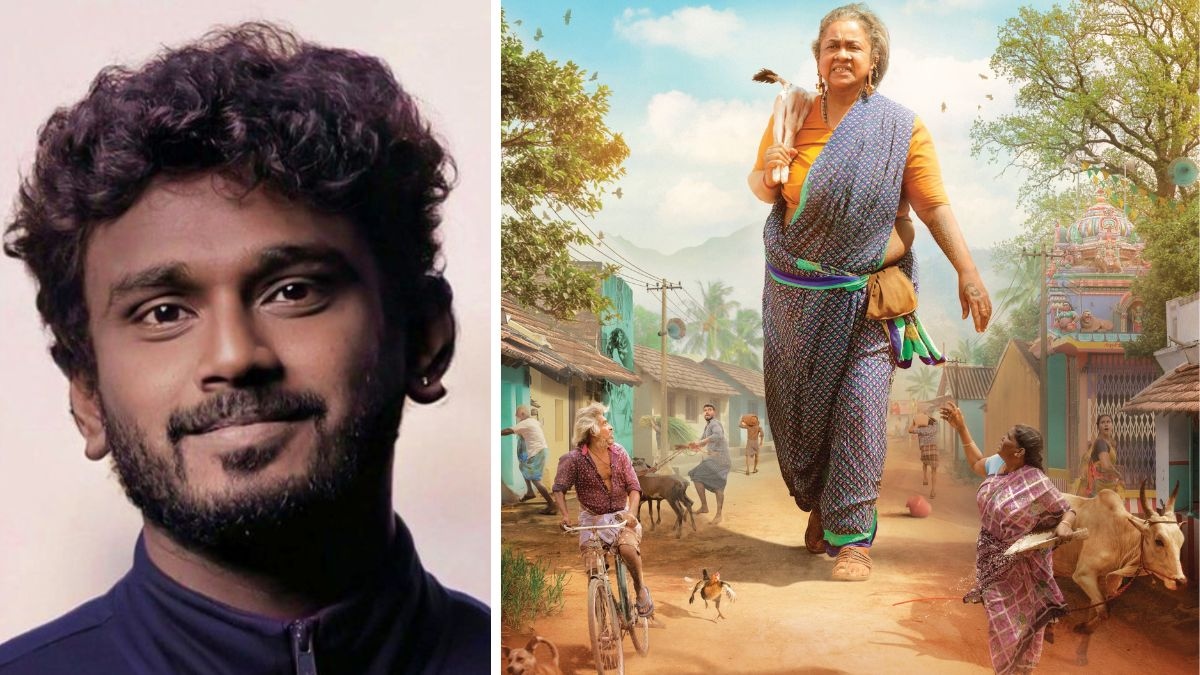
Filmmaker Sivakumar Murugesan (left); promo poster of his latest outing Thaai Kizhavi.
THAAI KIZHAVI starring Radikaa Sarathkumar in the title role, is winning hearts across the board. The film, about Pavunuthaayi who lives life on her own terms, her daughter Suruli (a wonderful Raichal Rabecca) and the extended family and village, has seen women heading to theatres in strength. The film has grossed more than Rs 75 crore at the box office, and is due to drop on JioHotstar in April. The film explores family relationships through the prism of power, finance and gender, and writer-director Sivakumar Murugesan draws deep into his lived experience to chisel a character unlike what we have seen on screen.The origin story of the film dates back some years, though. When he was an assistant to award-winning director M Manikandan on Kadaisi Vivasayi a film about elderly farmer Mayandi, Sivakumar was tasked with scouting for locations in Usilampatti, where they stayed for a year and a half. There, he met many elderly women and observed their lives. One day, in a village at about 6 am, he saw a little boy rudely pass on a jug of tea to an elderly lady sitting on the pyol, all the while castigating her for ruining his parents’ life and telling her to die. As a shocked Sivakumar watched, she composed herself and drank the tea. She did not know someone was watching her. Something broke that day in Sivakumar when it came to understanding violence towards the elderly and how they were being treated. “To think she had been relegated to the verandah and in a house she owned! This was a sight I saw very often: women who ended up spending their time in the verandah after slaving all their lives. That, I think, was the first spark for the movie.”
This visual kept playing in Sivakumar’s head even as he began writing his own script. “I’ve grown up surrounded by strong women who have contributed to their homes, got their kids into school and college, but I never saw those women on screen. In villages, even now, you can see elderly women who have raised eight or nine children, even after their husbands abandoned them. Their husbands only sought personal joy. They would be drunkards, waywards, some possibly remarried, but they would never be questioned, because society sanctioned their behaviour. And, the children were fed and raised and helped to set up their own families. They all felt their mothers were responsible for their well-being. I felt this was superhero content,” he says from the sets of his next, Seyyon starring Sivakarthikeyan, who has also produced Thaai Kizhavi.Sivakumar initially grew up with his grandparents before moving to Madurai, and says most of the women in Thaai Kizhavi bear characteristics of the women in his life. Because most of what he wrote came from lived experiences, Sivakumar, the director, was also clear that he would not over-explain. So, while one son gets a track where he realises the importance of a mother, the others don’t — it was shot and released on social media as a deleted scene. “I believe human emotions fluctuate. There’s no need for logical progression, really. For instance, I just wished for Pavunuthaayi’s daughter Suruli to speak to the sisters-in-law about her mother’s choices, and then cut to the climax. Anything more would have diluted the impact. At that moment, I decided as a storyteller, not a writer, who wants every character to have a complete arc.” Thaai Kizhavi actor Radikaa Sarathkumar on letting go of doing Indian: I did not want to put on that make-up
At the sets of Seyyon Sivakumar sits at a comfortable emotional distance from his debut film. “After the opening show, when I gave the audience the film, I switched off. Now, I do feel some of the expectation for my second, but I see that as a responsibility.”Sivakumar also changed the existing narrative to show that rural women do call the shots and are independent enough to do so. “All change does not begin in urban centres. Suruli, for instance, is an independent woman, but she’s not harsh; she does not ask for freedom; she owns it. She has financial freedom, and that is her biggest strength. She shows that it is possible to break free of shackles, but at the right time, you have to put in the work needed. This is also why I did not write her estranged husband, Rendu Idli, as a full-blown villain. Because I did not want anyone to distance themselves from his very relatable behaviour, and justify it by saying, 'he's the villain, this is what he will do'.”Thaai Kizhavi also posed an interesting irony — while Pavunuthaayi, at the fag end of her life, is seen enjoying her leisure, watching movies, eating all she wants and blowing bubbles in the air, Suruli and the other younger women are constantly working — cooking, washing, managing the fields… “I think that holds true of most women. They need to cross a certain age to allow themselves to be free. They are too intensely caught up in managing life.”
For those who hail from the Usilampatti, Bodi and Cumbam parts of Tamil Nadu, one of the character’s names would have brought a smile — Pennycuick, played brilliantly by Munishkanth, named after British Colonel John Pennycuick, under whose command workers built the lifeblood of the region - the Mullaipaeriyar dam. “You walk around that region, and you’ll find many Pennycuicks. That’s a landscape detail I love.” Thaai Kizhavi movie review: Radikaa Sarathkumar-Sivakumar Murugesan’s fiercely feminist, rural drama roars with humour and heart Pennycuick is also part of one of the most poignant scenes when he speaks of why he seeks marriage, not for someone to serve him, but for companionship, for knowing another human is waiting for him. “I was clear I wanted him and Suruli to get married, but I wanted his reasons to be almost divine. If not, the climax would fall flat. I remembered how, when I was 23 or 24, many of my friends were married. Most had children by the time I decided to marry. Once we were all speaking at night, and all 14 friends left, because someone wanted them home. I sat alone on my bike, thinking that one phone call is so valuable. Yes, my mother would call, but a wife calling to say the child was crying for the father pained me. And, I was only 30 when this happened. I imagined the pain of a man in a similar situation at the age of 40. I had options, but at that age, the possibility itself is low. I realised the value of having a second human open the door and tell you you’re loved and cared for.”The film landed the way it did because of Radikaa’s performance. But credit also goes to the writing. “When I was working on Kadaisi Vivasayi I got to spend a lot of time with Nallandi Ayya, 82. I think the layers to my film opened up because of what I experienced with him. He was absolutely nonchalant even after knowing he was acting in a part that was originally meant for Rajinikanth. I wanted to do for women what Manikandan sir did for an elderly man through this film.”Once he decided this was what he would work on, Sivakumar wanted to treat it commercially. “I visualised Thaai Kizhavi as a female goddess and treated her thus. She lives every day as a brand new one, treating it as a gift. “Pavunuthaayi is one of those rare people who do not bother about what people say. Everyone should enjoy their ‘me-time’,” says Sivakumar.
Nivas Prasanna’s music for the film has come in for much praise. And both Sivakumar and Nivas Prasanna are not the talking kind. “We can spend an entire day composing and not talking. I knew he would do something special. Whenever Pavunuthaayi is on screen, he gave her a BGM that melted people. I always visualise female goddesses with a background score of either the nagaswaram or the veena, and he understood that. If I pulled the chariot called Thaai Kizhavi for 80 per cent of the distance, Nivas took it to the end goal. He changed it to an experience,” the filmmaker remarks.The last scene of the film, which shows a sea of sisterhood, crowned by Pavunuthaayi sitting regally, has stayed with many women. It is almost like they finally felt seen on screen after years of being invisibilised or restricted to just being the kind grandmother. And that is one thing that makes Sivakumar very happy. “That’s all I wanted to do. Show women as they are, real and rooted, and not as people put up on a pedestal.”
Share
return(
)