OTTplay At Berlinale 2026: Liz Sargent's Take Me Home Is A Delicate, Daring Portrait Of Family
Meenakshi Shedde reviews Liz Sargent's Take Me Home — a delicate portrait of co-dependency between ageing parents and an intellectually disabled adult daughter, starring Sargent's real-life sister.
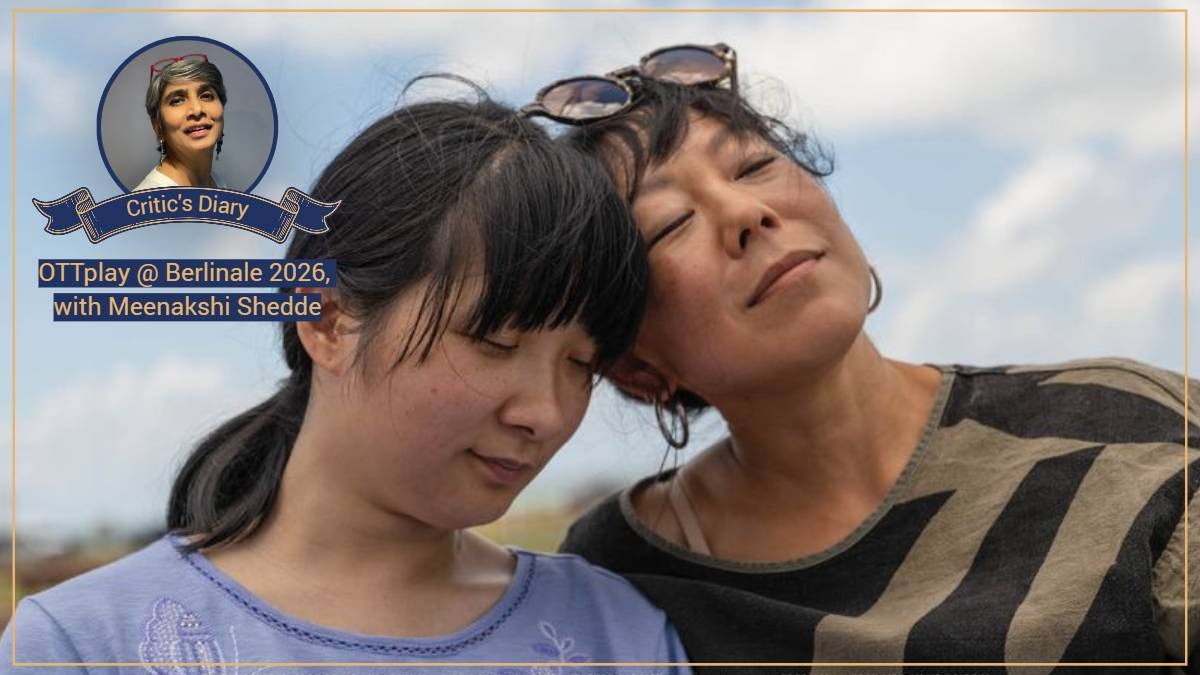
While the feature has some autobiographical elements, Liz Sargent boldly cast her real-life sister Anna, who is cognitively disabled, to play the fictionalised version of herself.
This review is part of award-winning film critic, journalist and curator Meenakshi Shedde's dispatches from the 2026 Berlin Film Festival for OTTplay.
***
TAKE ME HOME by Liz Sargent is a delicate American film of co-dependency between ageing parents and an adult daughter with cognitive disabilities, which was at the Berlin Film Festival last month. The film played in the Perspectives section, for debut fiction features.While the feature has some autobiographical elements, Sargent daringly cast her real-life sister Anna, who is cognitively disabled, to play the fictionalised version of herself. Both are also — in real life and in the film — Korean adoptees of a white American couple, played in the film by Victor Slezak (Bob/Dad) and Marceline Hugot (Joan/Mom).The film opens in a Florida home, as the elderly parents care for Anna, about 38 — the mother gently bathes her — and they cope patiently with her occasional tantrums. But there’s a teetering balance of fragility and dependency for both generations. A heatwave precipitates a tragedy, and when the sister Emily (Ali Ahn) rushes home from New York, she soon realises that the father also has dementia, and that both he and Anna need institutional care. She grapples with guilt as she returns to work — a familiar struggle for many. Their dad, unable to care for Anna or himself, is mortified to realise that the middle class cannot really afford institutional care. The film reaches its lowest ebb, before it shifts tone and imagines a playful, hopeful, sunshiny ending.
MORE FROM BERLINALE 2026 | Meenakshi Shedde Reviews Madhusree Dutta's Flying Tigers, About Assam's Forgotten WarSargent’s direction is superb, for the most part. She views all key characters with compassion, and encourages us to reflect on the abilities and kindness of those we consider disabled. The film underlines how inadequate the American health care system is in caring for people with disabilities and those from lower income groups. Alongside, she creates marvellously lived-in moments: of the father and daughter cooking together, of the family discovering that Anna is watching porn in her room. Anna is a wonder as the centre of the film — all warmth, spontaneity and a bit of a temper. Ali Ahn especially, and the parents, are superb counterfoils.Sargent’s nuanced screenplay observes prickly moments when Emily comes home, occasionally hinting at a we’re-doing-fine-without-you-resentment, a latent feeling of abandonment as she has ‘escaped’ to a full, busy life in New York. Emily too must slow down to their pace, and plays along when Anna mischievously steals a few ice creams from a store; they sit by the sea, watching giant cruise liners glide by. At one point, guilty and helpless, Emily asks her dad, “Why did you adopt someone with a disability?” There are also a couple of heart-stopping moments — the dad nearly running Anna over in the car, or the terrifying possibility that the drinking, macho garage-crowd she naively befriends might assault her. But Sargent consistently upturns expectations: the men are protective of her, and Anna herself is far more capable than anyone assumes. In doing so, the film quietly dismantles stereotypes about both disability and masculinity.
BERLINALE 2026 | Meenakshi Shedde Reviews Rima Das' Not A HeroIndian-American Farhad Ahmed Dehlvi’s cinematography uses close-ups to advantage, with muted tones indoors. His work also includes Academy Award-nominated Please Hold for Best Live Action Short, Green and Vishal Bhardwaj’s Khufiya. Producer Apoorva Charan (All Caps, Los Angeles, USA), earlier produced Joyland, directed by Saim Sadiq, the first Pakistani film to win the Cannes Film Festival’s Jury Prize in Un Certain Regard, and first Pakistani film to be on the Academy Awards shortlist for Best International Feature for 2023. Minos Papas (Cyprian Films) is the other producer. The women crew include director-writer Sargent; producer Charan; and executive producers Janet Yang (film producer, former President of the Academy of Motion Picture Arts & Sciences, and co-founder, Gold House), and Ai-jen Poo, leading voice in the women’s movement; sound designer Gisela Fulla Silvestre; costume designer Min Ji Kim and casting by Tiffany Canfield and Keertana Sastry.
FROM BERLINALE 2026 | Meenakshi Shedde Reviews R Gowtham's Members Of The Problematic FamilyWhile casting Anna Sargent as the protagonist is a bold, inclusive choice, previous American and Indian films have been inclusive in various ways: Marlee Matlin was the first deaf person to win an Oscar for Best Actress for Children of a Lesser God in 1987. Coda was the first film with a predominantly deaf cast to win the Academy Award for Best Picture; Troy Kotsur was the first deaf male actor to win an Academy Award (Best Supporting Actor), and Siân Heder won Best Adapted Screenplay in 2022 — a major milestone for deaf representation in Hollywood. American actor Peter Dinklage, who has dwarfism, is widely regarded as one of the finest actors of his generation: a Golden Globe, Primetime Emmy and Screen Actors Guild Award winner for Game of Thrones; with roles in Three Billboards Outside Ebbing Missouri and X-Men Days of Future Past to his name. For a person with a similar condition in Indian cinema, such a trajectory remains almost unimaginable. The relatively better Indian films portraying intellectually or otherwise disabled characters include My Name is Khan, Barfi, Margarita With a Straw, 15 Park Avenue (English), 16 Vayathinile (Tamil), and Astu (Marathi); but it is still quite rare to cast an actually disabled person as protagonist.
FROM BERLINALE 2026 | Meenakshi Shedde Reviews Sarmad Sultan Khoosat's Lali The Take Me Home team plans to do ‘impact screenings’ for communities and advocacy, and the short version was even screened at the White House, as part of the 25th anniversary of the Olmstead Act, which legislated against discrimination of people with disabilities. Before its Berlinale screening, Take Me Home had already won two major prizes at the Sundance Film Festival: Sargent won the Waldo Salt Screenwriting Award (U.S. Dramatic Competition), while Charan won the Sundance Institute-Amazon MGM Studios Producers Award for Fiction. The feature was developed from Sargent’s proof-of-concept short film of the same name, that screened at the Sundance and SXSW festivals, and on PBS; it won the Grand Jury Prize at the American Cinematheque's Proof of Concept Film Festival; The Academy’s Gold Fellowship for Women (Semi-Finalist 2024) and the AT&T Tribeca Untold Stories Award.
***
Meenakshi Shedde (Facebook | Instagram) is a National Award-winning film critic, journalist, curator and global influencer, shaping opinions on South Asian cinema worldwide since 40 years, based in Mumbai. She has been curator/programmer to TIFF Toronto, Berlin and film festivals worldwide. She has been jury member of 25 film festivals, such as Cannes, Berlin and Venice, including the jury of Cannes’ Semaine de la Critique (Critics’ Week) 2023, and was also Golden Globes international voter.Share