Home » Features » The Sreenivasan Effect: Unmatched, Unreplicated
Features

The Sreenivasan Effect: Unmatched, Unreplicated

Sreenivasan didn’t just redefine slapstick but rescued it from frivolity and anchored it firmly in lived reality. His humour was always disruptive, unsettling, and often uncomfortably honest.

Neelima+Menon
Dec 23, 2025

If one were to truly distil Sreenivasan’s contribution to Malayalam cinema, it would be that he created a cinematic language so singular that it resisted replication.

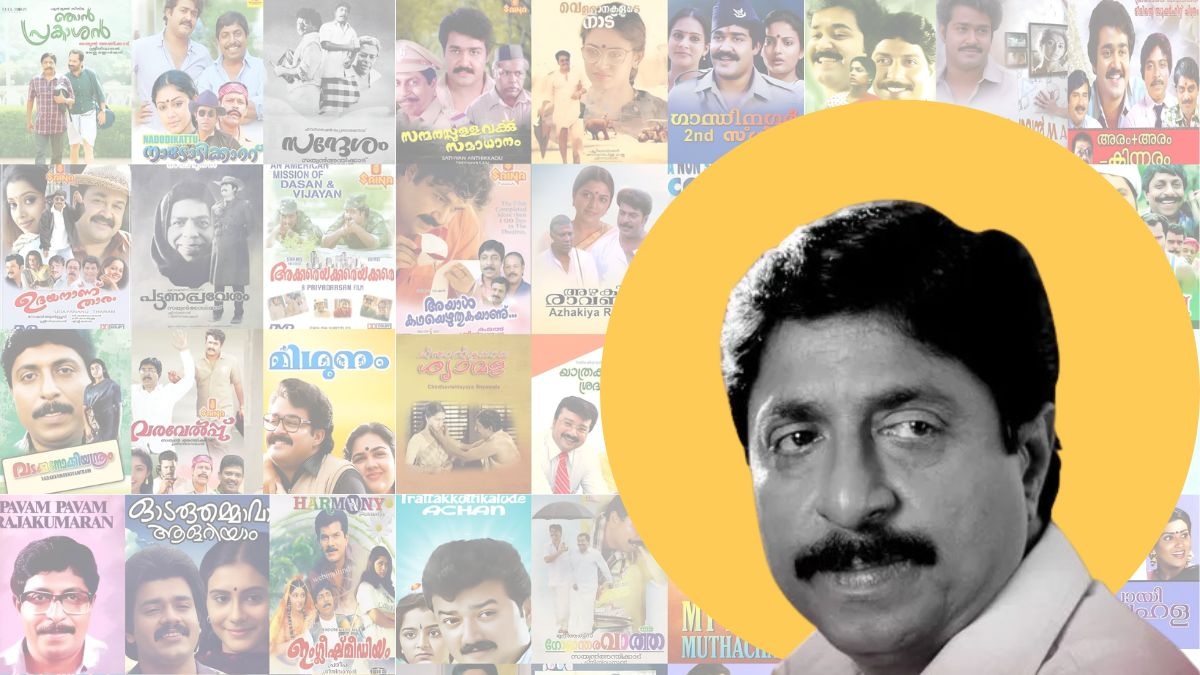
ONCE in an interview, actor–writer–director Sreenivasan, when asked about his greatest contribution to Malayalam cinema, quipped that it was the hundred-odd films he had rejected. This throwaway line in a way revealed an artist who understood restraint, discernment, and the quiet power of saying no in an industry obsessed with visibility and volume. Although Sreenivasan made his acting debut in the 1970s and appeared in films by auteurs like KG George and G Aravindan, his true calling emerged when Priyadarshan nudged him towards screenwriting. And while he went on to act in over 250 films, it was his screenplays (44 films) that firmly cemented his identity in Malayalam cinema. Few writers made Malayalam cinema laugh, reflect, and recognise itself the way Sreenivasan did.If one were to truly distil Sreenivasan’s contribution to Malayalam cinema, it would be that he created a cinematic language so singular that it resisted replication. None could recreate the genius that emerged from his particular blend of irony, empathy, and social observation. One can safely say that he didn’t just redefine slapstick but rescued it from frivolity and anchored it firmly in lived reality. His humour was always disruptive, unsettling, and often uncomfortably honest.

Stream the latest Malayalam, Tamil, Telugu and Kannada releases, with OTTplay Premium's Power Play monthly pack, for only Rs 149.

Thalathil Dineshan remains one of the most radical portraits of male insecurity in Malayalam cinema. At a time when masculinity was explored through ideological battles or performative angst, writer Sreenivasan, in his debut directorial Vadakkunokkiyanthram (1989) chose fragility over assertion. Dineshan’s anxieties about his body, sexual performance, and self-worth are internalised and unspoken, and are made sharper by his marriage to a woman whose beauty only seems to deepen his sense of inadequacy. What makes Dineshan so painfully real is that his insecurity never erupts into rage or dominance; instead, it folds inward, leaving him emotionally unstable. In that sense, Dineshan is not just a character but a quiet rupture in the way Malayalam cinema had imagined men until then. He is neither idealised nor mocked beyond repair. He is pitiful, poignant, and achingly familiar, a portrait of male vulnerability that sits with discomfort. And it is precisely this refusal to dramatise insecurity that makes Thalathil Dineshan endure as one of the most honest explorations of masculinity the industry has produced.In Sreenivasan’s second directorial, Chinthavishtayaya Shyamala (1998), which arrived nearly a decade after his critically and commercially successful debut, the story once again pivots around a weak man. Vijayan is a schoolteacher who shirks responsibility not just as a husband and father, but even in his profession. His restless job-hopping and get-rich-quick schemes are more about a sustained flight from accountability than about being ambitious. The Sreenivasan brand of wit is on full display here — take this now-iconic moment when Vijayan attempts to direct a movie, utterly clueless yet supremely confident, barking “Start, take, action, cut” in one breath, and snapping back, “Which part of this you don’t understand?” Vijayan is sketched in a way that invites pity rather than ridicule. ALSO READ | Mammootty to Mohanlal: How Sreenivasan helped shape Malayalam superstars’ careers
Running parallel is Shyamala, quietly holding the household together while absorbing his failures. But then, without grand speeches or dramatic assertions, she gradually steps into agency, choosing to take control of her life. In contrast to Vijayan’s evasions, her strength feels earned and all the more powerful for its restraint.From Priyadarshan’s oddball comedy to Anthikad’s gentle ordinariness If Sreenivasan’s two directorial films captured the most undiluted essence of the writer, the films he wrote for others shapeshifted to accommodate the worldview and cinematic grammar of each filmmaker. So Priyadarshan’s fondness for kinetic staging, exaggerated situations, and oddball framing amplified the writer’s satirical bite, turning social critique into buoyant, chaotic comedy.It is also deeply ironic that, despite Priyadarshan often operating through a borderline feudal and politically incorrect gaze, Sreenivasan consistently populated those worlds with characters who actively disrupted that worldview. In Mazha Peyyunnu Maddalam Kottunnu (1986) for instance, Sreenivasan turns his satirical lens on bourgeois hypocrisy, populating the narrative with deliciously exaggerated caricatures. MA Dhawan (one of Sreenivasan’s finest outings) parades his classism with smug self-importance, while cousins Sardar Krishna Kurup and Koma Kurup are locked in a petty feud that is more about social one-upmanship and performative status. There are instances when he uses absurd humour to expose the elitism that often disguises itself as artistic and political righteousness.
In sharp contrast, with Sathyan Anthikad, the same writing underwent a gentle recalibration. If Sreenivasan’s socio-political critique remained intact, Anthikad ensured that its sharp edges were softened without ever being blunted. Nadodikattu (1987) remains the most popular collaboration between Sathyan Anthikad and Sreenivasan, introducing two of the most iconic characters in Malayalam cinema — Dasan and Vijayan. Ordinary, unemployed, and perpetually out of place, they confronted the world armed only with wit, misplaced confidence, and hope.It was also Anthikad who was instrumental in forging the magical on-screen synergy between Mohanlal and Sreenivasan. From Sanmanasullavarkku Samadhanam and Pattanapravesham to Varavelppu and Udayananu Tharam Mohanlal’s effortless naturalism played beautifully off Sreenivasan’s self-conscious awkwardness. Together, they created a chemistry rooted not in heroism or bravado, but in vulnerability, one that felt deeply familiar and therefore enduring. This partnership, which brought Mohanlal immense love, laughter, and lasting popularity, also shaped an era of Malayalam cinema. More importantly, Mohanlal gave a living, breathing face to Sreenivasan’s everyman — grounded, flawed, and achingly human.
In Sathyan Anthikad’s Sandhesam (1991) Sreenivasan demonstrated how cinema could be defiantly political at a time when popular films oscillated between loud sloganeering and carefully coded symbolism. At its core are two brothers aligned with opposing political ideologies, whose conflicts spill from party offices into domestic spaces, exposing how ideology fractures families as much as it claims to serve society.What makes Sandhesam particularly audacious is Sreenivasan’s refusal to exempt his own ideological leanings from scrutiny. A self-professed leftist, he openly skewers the Left’s intellectual arrogance, performative activism, and moral hypocrisies. The film ultimately strips politics of its rhetoric and reduces it to a deceptively simple ethic — before attempting to change the world, one must first learn to be humane at home. In that sense, Sandhesam remains not just a political satire but a moral reckoning.
That said, his portrayal of women rarely stepped outside a patriarchal gaze. While Sreenivasan was relentless in puncturing male ego and insecurity, his female characters were often confined to conventional sketches. In Thalayanamanthram (1990) Kanchana, whose only transgression is aspiring to a better standard of living, is ultimately made to apologise and retreat to restore domestic “sanctity.” Similarly, Sulochana in Midhunam (1993) merely seeks her husband’s time and emotional presence, yet the narrative frames her desire as excess, demanding correction rather than understanding.In Oru Maravathoor Kanavu (1998) this limitation becomes more pronounced, with the writing slipping into overtly regressive ideas about a woman’s place in society. The irony is hard to miss: an artist so incisive in exposing social hypocrisy is unable to extend the same radical empathy to women, thereby choosing reconciliation with patriarchy over a deeper interrogation of it.
Interestingly, the emotional weight in Sreenivasan’s writing is rarely accorded the same attention as his celebrated satire. Yet, some of his most enduring moments are rooted in quiet feeling rather than comic bite. In Sandhesam Thilakan’s extended monologue on parenting and responsibility resonates deeply with anyone who grew up in the 1980s. The passage where Dasan mourns his mother’s death in Nadodikattu is devastating precisely because of its restraint. Similarly, Udayan’s unspoken love for Madhumati in Udayananu Tharam carries as much emotional charge as his explosive tirade against Superstar Saroj Kumar. The climactic epilogue of Sankar Das addressing Anuradha on the complexities of love in Azhakiya Ravanan, and Superstar Ashok Kumar’s deeply evocative meditation on friendship in Katha Parayumpol, further attest to this emotional range.Taken together, these moments reveal a writer whose craft was not limited to satire alone. Sreenivasan’s writing adapted, sustained, and thrived across multiple cinematic worlds and showed that he was secure enough in his voice to let it be refracted through different tones, genres, and emotional registers.
Perhaps Sreenivasan’s most enduring legacy lies in his dialogues. They were deceptively simple lines that twisted the banal into the absurd, infusing everyday speech with a peculiar wackiness, and quietly included themselves in public memory. So, Nadodikattu’s “What a beautiful impossible dream” has become shorthand for unfulfilled aspirations. “Don’t say a word about Poland” from Sandesham is invoked whenever an argument is best avoided. “Dasa, everything has a time and place” captures the fragile optimism of hope and serendipity, while “I have learned Polytechnique” from Thalayanamanthram is deployed to mock inflated, imaginary expertise. And “my head, my full figure” from Udayananu Tharam has come to neatly describe unchecked vanity.These lines endure because they slipped effortlessly into everyday language, becoming cultural shorthand and proving that Sreenivasan didn’t just write dialogue for cinema, he simply rewired how people spoke about their lives.Long after the films ended, those words lived on, in homes, in arguments, in humour, in the collective consciousness of a generation. In the end, Sreenivasan’s irreverence was never about mockery for its own sake. It was an ethical stance. A refusal to flatter power, to sanitise reality, or to offer easy catharsis. And that, more than anything else, is why his genius remains unmatched.

Watch Sreenivasan's best filmssuch as Katha Parayumpol, Sanmanassullavarkku Samadhanam and many more films with OTTplay Premium

Share
return(
)