Home » Interview » The Mari Selvaraj Interview | 'Only In The Face Of Vulnerability Does Heroism Hit Harder'
The Mari Selvaraj Interview | 'Only In The Face Of Vulnerability Does Heroism Hit Harder'
In a conversation with Subha J Rao the filmmaker talks about his latest outing, Bison Kaalamaadan, the teachers who shaped him, and the politics, pain, and quiet tenderness that fuel his cinema.
Nov 20, 2025
undefined
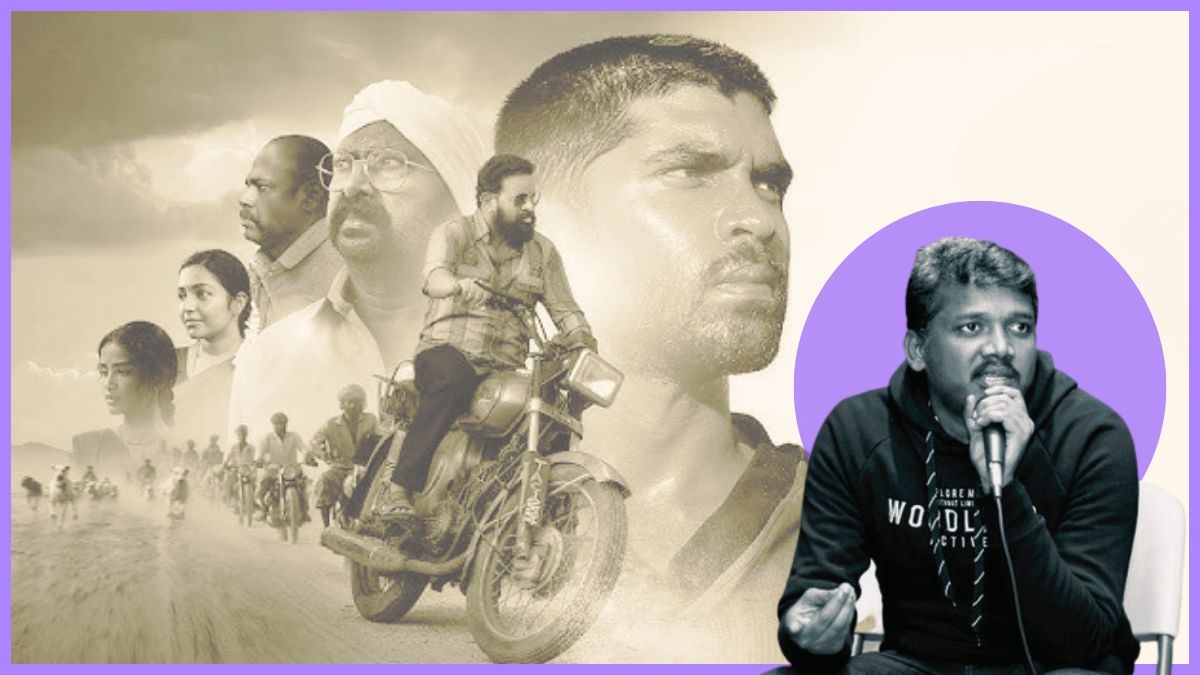
MARI SELVARAJ'S Bison Kaalamaadan is more a force of nature than a film. Kittan’s journey to wearing the India jersey and representing the country is written and directed as a rousing drama, but with a healthy dose of subtlety. Fear, people’s generosity, caste discrimination, benefactors and love exist, but silently. But the silences speak so loudly, you end up rooting for Kittan long before the script turns him into a hero.
Selvaraj’s fifth film, based on Arjuna Award winner Manathi Ganesan, is also proof of his learning curve — the craft is sublime, but the focus is always on the story. Everything else serves it.
Over the years, the director has been praised and criticised for the exact same things, much like his films and his politics. But Selvaraj says he chooses to move on, owing to certain choices and apologising for others.
In an hour-long conversation, the director, one of the very few who make time for print interviews, speaks of the creative choices made for Bison Kaalamaadan and his love for teachers and animals. He also addresses some valid criticism. Edited excerpts below:
From when you began to now, how do you see your growth as a storyteller? Is your craft work-in-progress?
I like to believe I am first and foremost a storyteller. When I first began writing and telling my stories as an assistant director, I did not have craft, but only confidence. My focus was simple. If a director asked me where I was from, how I would make them understand me, and what incidents could help in that process.
Eventually, it was my short stories, poetry and essays that paved the path for me to enter the world of cinema. And then, I began working on my craft.
Even today, when I make a movie, the goal is that no one should reject my story. My story has to somehow reach people. And that is where craft comes in. It helps me get through to people.
This must have been an arduous journey...
My family and friends always question me as to why I work so hard. But I am learning, not working. I am a work-in-progress, and I still have to learn how to land better, how to make myself better. Life is my teacher.
Interesting you speak about learning. Teachers play an important role in all your films, right, including Bison’s Santhanaraj?
I am nothing without my teachers. They’ve taken care of me since I was a child, they’ve identified a talent in me, and helped me hone it. They saw that this boy can look beyond books. I fondly remember my teachers, beginning with Pechiammal, Isakiammal, Kaliyammal, Padma, and Shekar Sir… each one of them chiselled me. And then, I came under the tutelage of director Raam. If I had not seen a teacher in him, I would not have surrendered myself to him. He created Mari Selvaraj.
Teachers work so hard, without expectation, just to educate students, to bring about social change. Imagine they identify the hidden talent in each student just within the four walls of a class. They meet so many students across social strata, but remember their initial and roll number! I could not have done anything without my teachers. I love the role they play so much. I am married to a teacher.
You are also a good teacher. Your films make the education of what privilege means very accessible. People see things they might have never been exposed to, without being intimidated.
You’re referring to the cutting of caste threads tied on children’s wrists before a competition. Only when these threads snap will a bond be formed between Kittan and his teacher. I have borne the brunt of these caste threads as a student. They should have no place in sport.
Such discrimination can either turn you violent or make you someone who walks the middle path and seeks to bring in change. Why did you choose your path?
We all learn every single day. Growing up, some days, I felt I needed my caste identity. Some days, I wondered why it was necessary. I grew up amid that confusion. It all boils down to how discrimination changes you. When a classmate who looks like you, dresses like you, and treats you badly, you wonder: “Why does he think he is different? Why does he want to control me and those like me? Why does he want to tame me? I only feel pity, wondering if he does what he does with knowledge or the lack of it. I keep wondering how to convey that casteism triggers aruvaruppu (repulsive).
Once you know where that sense of discrimination comes from, it is easier to handle that person. When you win, it is vanquishing their thought process. But real success is living together. This will come after great resistance, followed by discussions and arguments.
Did your fascination for the arts trigger this thought?
Yes, definitely. I might have been like anyone else but for art and books, and cinema, and poetry. Art has the ability to help you travel, though you’re sitting in one place. Also, art is always used to unify; it does not seclude. Art should not be used for political revenge. Art should make you sit down together and discuss (Koodi amara vaithu, uraiyaaduvadhu). I am only being true to art.
Bison, like your other films, shows the intimate bond between humans and animals. The plight of the piglets in Maamannan broke so many hearts… people still remember Karuppi. Where does this fondness for animals come from?
I think this love began early on in life. I grew up alongside goats and cattle, cats and dogs, and spent so much time with them, had conversations with them, and fought with them.
Love for animals is almost universal. I always seek metaphors, and when I wanted to show innocence being hurt, I chose to do it through animals. It is a podhuvaana uyir (a being common to all), and when something happens to animals, it hurts all. I also see them as healing agents. In the village, two people from different caste locations might be grazing their goats. They can dislike each other and won’t speak, but both love their goats. This is why I thought of using animals, because they are a binding force.
In Bison, you’ve extracted some amazing performances from actors known for their craft as well as others. How did you choose your cast?
I first have conversations. I make them understand my process. Then, they need to know where I am from and how I look at cinema, and what my intent is in making a film. They need to know me beyond my cinema too — my politics, my views on social justice. If this works, then we embark on a journey, and they enter my world.
When I work like this, my filmmaking process becomes easier too. Every character comes with a certain belief system, and the actors are willing to put in the work to internalise that.
I always tell my cast that box-office success is important, but no one can predict it. What we can definitely predict is the joy in the process. No one can take away from us that we were part of a good film. Society cannot ignore that hard work. Apart from this, I put in work on my own to ensure my team shines. That is what you see on screen.
We see something on screen in Bison, but you’re also hinting at a past that is not apparent. For example, the father Velusamy’s familiarity with knives, but also his hesitation to carry one…
I wanted you to know he has a past. His face is fraught with tension when he has to carry a knife, but the way his hands move, you know he’s done this countless times. I wanted that contrast between muscle memory and the face, and Pasupathi Sir did a fabulous job. You understand his character when he never takes the knife from the same place. He keeps safeguarding it from others and himself — it’s almost like he has a separate struggle with the knife.
You’ve always been asked questions that might not be posed to others, sometimes because people hold you to a higher standard. And so, I have to ask you, why the decision to use rapper Vedan’s voice for a song when he’s been accused of a crime?
Because you’re asking me this from an emotional place, let me answer you. He’s like a brother; we come from similar backgrounds. I thought of it this way: What if he felt that this brother of his also let him down? If he’s proven right and I had not backed him, I would lose him forever. That said, I assure you that if he’s proven guilty, I will openly ask for forgiveness from all. That’s what my conscience will demand. That’s the right thing to do.
The other frequent criticism is casting fair actors and brownfacing them, which happened in Bison too…
I choose actors who are committed to my idea of the story, and then turn them into the character I see them in.
Yes, the women in my films look tanned, but that’s the reality of where I come from. My mom was so fair till she started working in the fields. My sister looks very different in her 9th-grade school photo. Her colour changed once she began working. The tan, the chipping of the nails, all these become very common. If you work in the fields, you will look a certain way. This is why Jyothi (Anandhi) of Pariyerum Perumal looks how she does. She’s a college-going girl, unlike Rani and Raji.
Mari, what role do women play in your life and films?
I see women as hope, as life’s highest hope (uchakatta nambikkai). They have helped me, understood me, and made me better. I see them as people who offer immense faith in humans.
You show Kittan as someone very vulnerable. How did you write this arc of your film’s hero?
Only in the face of vulnerability does heroism hit harder. When a person has lost so much — people, things, opportunities — there’s a pain in them that’s unreal. All they want, and all you want for them, is for the pain to stop. They are exhausted, and yet they keep working for a tomorrow that seems far away. When that tomorrow comes, it hits hard, because the said person has shared their emotions openly. And, in a way, you make their struggle yours.
Your team — cinematographer Ezhil Arasu, editor Sakthi Thiru and composer Nivas K Prasanna — has been your backbone for Bison…
They are my pokkisham (treasure). They enter my world, trust me, and put in the work needed to bring this vision to fruition. The confidence and pleasure you experience when you see that kind of faith from your team…is unlike anything else.
Stream the latest Tamil, Malayalam, Telugu and Kannada releases, with OTTplay Premium's Power Play monthly pack, for only Rs 149.
Share