Home » Interview » Subedaar director Suresh Triveni on 'reel-cut' culture: 'Would rather chop off an entire scene than butcher it' | Exclusive
Subedaar director Suresh Triveni on 'reel-cut' culture: 'Would rather chop off an entire scene than butcher it' | Exclusive
In an exclusive interview with OTTplay, Suresh Triveni talks genre-hopping from Tumhari Sulu to Subedaar. He explores visual metaphors and the "out-of-body" trip of directing Bollywood legends.
Mar 18, 2026
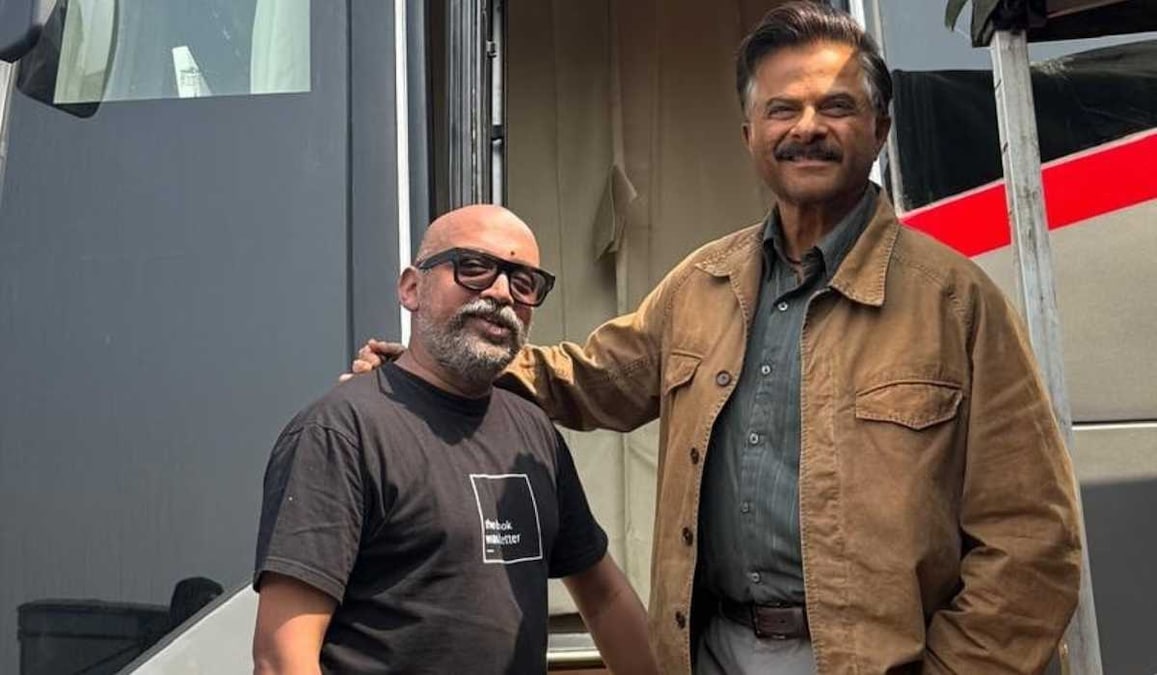
Suresh Triveni and Anil Kapoor
From the warm, fuzzy embrace of Tumhari Sulu to the gritty, high-stakes tension of Jalsa and the hard-hitting "unreal drama" of Subedaar Suresh Triveni has proven that he’s a filmmaker who refuses to be "indexed". He is a creator who thrives on the nervous energy of the unknown, blending his Ranchi upbringing, Malayali roots, and a formative stint in Chennai into a language that feels both hyper-local and universal. In this exclusive interview with OTTplay, Triveni opens up about his "potluck" filmmaking journey—a path that has seen him move from the world of advertising to directing icons like Anil Kapoor and Madhuri Dixit, all while maintaining the soul of a "Ranchi boy" who just wants to make the kind of movies he’d actually want to watch.
Experience the peak of Indian cinematic grit—from the visceral underworld of Satya and the high-octane valour of Uri: The Surgical Strike to the haunting, poetic depth of Haider—all available to stream now on OTTplay Premium.
We dive deep into his unique directorial philosophy, exploring his obsession with inanimate objects—like the symbolic red Gypsy in Subedaar—and his staunch commitment to pacing over the modern "reel-cut" culture.
Edited excerpts below...
It's been more than 10 days since the release of Subedaar. Did you anticipate the buzz and reactions from people around?
Suresh Triveni: How can you anticipate? In this world of so much noise and content, you want to do well. That’s the most you can ask for because of the hard work that has gone in. It was a very aware call as to how I went about the film and how we were mounting it. The most heartening part was that a lot of filmmakers from across the North and South reached out to me. I know how difficult it is to make a film and then to mount it, so I got a lot of love from filmmakers, which was very good. Right from Anurag (Kashyap) sir to Hansal (Mehta) sir, Mahesh Narayanan, Gautham Vasudev Menon, Karan Johar, and Shah Rukh Khan—they were all very kind to me.
At the trailer launch, you spoke about being a "Ranchi boy." Looking at Tumhari Sulu and Subedaar you have a very non-Mumbai lens. Tumhari Sulu felt middle-class and suburban, and Subedaar feels grounded in heartland India. Does being from Ranchi stop your stories from becoming "too Bollywood"?
Suresh Triveni: My influences are unique. I am a Malayali boy who grew up in Ranchi. You grow up with all kinds of films—Malayalam, Tamil, Hindi—and you subconsciously pick your favorites. My influences were very early, right from Sathyan Anthikad in Malayalam to Mani Ratnam, Ram Gopal Varma, and Manmohan Desai. The choices were extreme!
There’s a certain commonality between Tumhari Sulu and Subedaar—both are nostalgia for me. Tumhari Sulu was about going back to that warm, fuzzy Hrishikesh Mukherjee space. In Subedaar it was about the sights and sounds I heard as a kid in Ranchi during Durga Puja, where they played movies on an open ground. I wasn't allowed to go to all of them, but those sounds played a huge role in my growth. Somewhere, I wanted to give a tribute to that. People who saw Tumhari Sulu said it’s like a Malayalam film. Because I like Sreenivasan’s films and that kind of screenplay, you naturally borrow from that.
People often forget your stint in Chennai before coming to Mumbai. How did that influence your process?
Suresh Triveni: I actually did my graduation in Chennai. I joined a course called BSc Visual Communication at SRM College. That is where I was exposed to English and international cinema for the first time. Chennai has such a buzzing movie culture. Every conversation, whether at home or outside, would lead to a Thalaiva film. For me, it was heavily Mani Ratnam. I also ended up working in a music channel there called SS Music, so I had access to so many songs.
Subconsciously, it helped me. At that time, apart from cricket, you only spoke about cinema. I remember the influence of Dharani’s films, the pop culture of Vikram’s films like Dhool and Alai Payuthey or Aayutha Ezhuthu. Those influences were constantly triggering me to do something like that. I am a complete potluck filmmaker.
You’ve moved from slice-of-life to a moral thriller Jalsa to heartland action Subedaar, and now a dark comedy Maa Behen. Are you deliberately trying to avoid being indexed, or is this just a restless creative mind?
Suresh Triveni: When Tumhari Sulu released, it came out of absolute purity. I was not from the industry; I just made a film I wanted to make. After it did well, people made me aware of my "nuancing." The next time I started writing, I felt I was faking it. I realized that when you pursue one genre and try to copy yourself, you are cheating yourself and you lose that freshness.
I want to make films that I want to watch across all genres. I want to feel nervous while making a film because this is a hard-earned dream I am living, and I can't take it for granted. I do advertising and I’m proud of it, but for a feature film, you need to feel like you’re doing the genre for the first time. After Tumhari Sulu I wanted to do something like Maa Behen—I wrote it immediately after, but got stuck and moved to other subjects. My filmography is very erratic—2017, 2022, and then 2026. I go by what I genuinely feel like making. It has to feel new to me.
My filmography is erratic—2017, 2022, and then 2026. There is no plan. In Subedaar I wanted to have that father-daughter relationship right in the center of it. It’s about a crack in a relationship and a lack of communication. I want to feel new about every genre I attempt.
In Subedaar the most talked-about elements are the Red Gypsy and the missing gun. How did you make those objects speak as characters?
Suresh Triveni: For me, the red Gypsy is actually the mother. That’s the only place where the father and daughter sit together; it’s a tangible memory. The Gypsy gets wrecked through the film, mirroring the relationship getting wrecked. The mother is still trying to hold it together. I love inanimate objects having significance. In Jalsa it was the "what if"—what if someone comes under your wheel? It was morality coming under the wheel. In Subedaar, the Gypsy was the mother linking the father and daughter. The pickle was the "taste," and the form was the Gypsy. That’s why the final resolve is inside a wrecked Gypsy.
Regarding the gun—the film is actually my take on territories. From the guy taking a leak in the jeep to the parking issues, it’s a very territorial film. In Middle India, a gun is pride. We are a pride-led society; "sorry" is not the first thing that comes to us. The gun stands for this obnoxious patriarchal pride that the boy carries. When that goes missing, the guy goes berserk. It is a journey of that pride reaching the right place, which is Shyama’s (Radhikka Madan) hands.
The film has chapter titles like 'Janamdin' or 'Anniversary'. It reminded me of Jalsa where the title card only appears during an actual celebration. How do you decide on that?
Suresh Triveni: I’ll give that to my editor, Shivkumar Panicker. He likes chapterization because he feels it controls the thought process. We actually did this film even before Dhurandhar and the edit was done before its release. In today’s dwindling attention span, it’s not a bad idea to chapterize to give a sense of moving from one point to the next. It was never written in the script like that; it was done at the edit level.
I love titles. In Jalsa we put the title near the end and we were jumping with joy. Similarly in Subedaar, the title happens at the point where he flips—and not necessarily for the good. Until that point, he maintained his pride and the soldier within him. After that title, rage follows. One action was stylised, the other was like a beast.
As an ad filmmaker, you have 30 seconds to make a point. In a film, you have two hours. What is one thing you refuse to unlearn from advertising?
Suresh Triveni: Advertising teaches you the "moment" and the "penny drop." You can't unlearn those. Even in a feature, I look for that. I don't treat a scene like an ad—that’s the worst mistake you can make. When I showed the first cut of Tumhari Sulu to Sanu John Varghese, he told me, "Every scene of yours looks like an ad; it’s got a start, middle, and end." That was a huge learning. In feature filmmaking, you can start in the middle or leave it open-ended. But when you're in the edit and find a lag, that’s when the advertising learning helps to shave and shave to bring a moment alive.
How do you fight the urge to cut faster, especially with current attention spans and "reel cuts"?
Suresh Triveni: It’s very difficult because you’ve grown up on a certain kind of cinema. In Subedaar I was very clear I wanted it to brim until the 40th minute. I didn’t want his violence to be irresponsible. We were testing the audience's patience—it’s a tribute to something like Baasha where a guy is constantly waiting until something unpardonable happens. I would rather chop off an entire scene than butcher it. In Subedaar, scenes were taken off purely to keep the pace in mind. But I will never compromise on the cinematic quality. I think that is being compromised in mainstream cinema. Subedaar had a neo-western space, and it needed those specific camera movements and track-ins.
Radhikka Madan mentioned she trained extensively for Kabaddi, but those sequences were edited out. Was that heartbreaking for you?
Suresh Triveni: Every time you take something off, you are the most hurt. But the Kabaddi came into play in her stunts. In the attempt-to-rape scene where she escapes, every move is a Kabaddi move. She actually does a "Kainchi cut" when she grabs his neck and falls off. You don’t need a 20-second sequence of a match to show she’s an athlete. It’s about a self-reliant girl who takes up a sport to get a government job via the sports quota. When she is being dragged in the mud, it’s happening in a room that looks like a Kabaddi court. She unties herself, flips over them, and even when they hold her leg, she finds a way out. That is a result of her being a Kabaddi player, but showing a match wouldn't have convinced me as much as seeing how that skill resulted in her survival.
You’ve watched films like Tezaab and Parinda growing up. When you're directing Anil Kapoor and Madhuri Dixit, how long does it take for the "fan" to leave the room so the "director" can give a tough note?
Suresh Triveni: It’s a tough one. You have an out-of-body experience. It mostly happens just before the scene. Once the camera rolls, nothing matters to me. But when they come and sit with you, and Madhuri Ma'am or Anil sir ask for direction, that’s when the enormity hits you. The "Ranchi boy" in me still gets a little out-of-body. In this film, we’ve given enough Easter eggs—there is "Munna" on the lighter, and in the lawyer sequence, you see "Thakral," the villain from Meri Jung. It’s a tribute, but it’s overwhelming.
In Daldal Tumhari Sulu, or Jalsa, you show the interior lives of women. In Subedaar, you're dealing with a soldier and a father. Did directing masculinity require a different emotional vocabulary?
Suresh Triveni: I never treat characters from their gender angle first. I treat them as characters. I am sensitive about the gender part and I check and counter-check my decisions, but when you are working with credible voices like Vidya, Madhuri, Shefali, or Bhumi, they guide that. Technically, they are all the same to me—it depends on what the genre deserves. In Jalsa it was a moody psychological drama. Tumhari Sulu was an intimate, warm space. For Subedaar, I didn't look at how I was treating masculinity; I just stayed true to the neo-western technique.
With Daldal Subedaar, and Maa Behen all hitting the public within months of each other, what has it taught you as a filmmaker?
Suresh Triveni: If ten years ago someone told me I’d have three releases in 2026, I would not have been kind to them! We are living in a time of noise. A movie releases and then there’s this whole plethora of voices that just bombards you. Currently, I am still living in that noise. I think after six months is when I’ll really be able to reflect. The only good part is that both have been received with love. I just hope the hard work pays off for my producers and for me as a director.
Are you afraid of burning out?
Suresh Triveni: That’s exactly the reason I jump genres. While it seems they came out in one year, they were in different stages. The series took the longest. The fear of burnout is always there because you are constantly living in self-doubt. But after this, I’m dying to do something for kids, something in the world of horror, and something in comedy. Looking for new stories keeps you fresh. And thank god for books!
Tumhari Sulu is still a film I watch twice a year
Suresh Triveni: My mother is still waiting for me to make another Tumhari Sulu! I’m blessed because the mileage of that film has taken me this far. Vidya Balan messaged me recently saying she can't believe the guy who made Tumhari Sulu made Subedaar. I remember one review said the film feels like a "warm hug," and that was the intent.
Subedaar ends with a hint of something more, including the inclusion of Nana Patekar. Are you taking that forward?
Suresh Triveni: We definitely are working towards a story. There’s nothing official yet, but internally my team has an idea around it. The Nana Patekar cameo was something we were constantly looking for. Anil sir spoke to Nana sir, and he was warm enough to come on board for that surprise. My writer, Prajwal, has been my backbone—he wrote Jalsa and this. You should have seen his joy writing Nana’s lines; he was like a kid in a candy shop! He wrote at least ten options. For him, writing for Nana Patekar was something else.
Top 6 Landmark Indian Films
Share