Home » Reviews » Jolly LLB 3 review: Akshay Kumar’s saviour streak overshadows Arshad Warsi in an entertaining yet uneven courtroom drama
Jolly LLB 3 review: Akshay Kumar’s saviour streak overshadows Arshad Warsi in an entertaining yet uneven courtroom drama
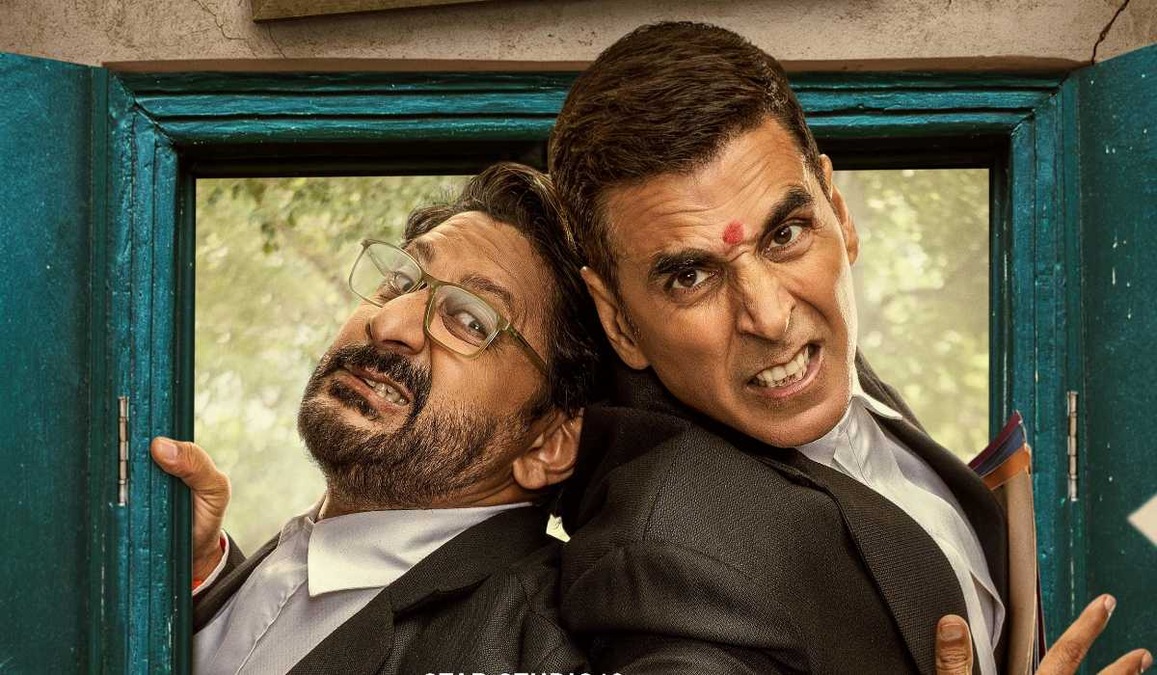
Jolly LLB 3 pits Akshay Kumar and Arshad Warsi’s Jollys in a satirical courtroom battle over a farmer’s widow’s fight for justice, blending comedy, drama, and social critique with uneven execution.
3.0/5
Sep 19, 2025
Jolly LLB 3
Jolly LLB 3 story:
In a hilarious and satirical courtroom drama brimming with high-stakes emotions, Jolly LLB 3 pairs Akshay Kumar and Arshad Warsi as Jolly Mishra and Jolly Tyagi, respectively, as competing lawyers. The plot is on Janaki (Seema Biswas), a farmer's widow who, following her husband's untimely death, challenges a huge business empire. Their dispute leads to a court battle that pits the two Jollys against each other, with the ever-exasperated Judge Sunderlal Tripathi (Saurabh Shukla) mediating. The film pursues the themes of ambition, corruption, and justice while maintaining the series' signature blend of comic and social commentary through its clever courtroom banter, emotional depth, and intelligent conflicts.
Watch Kaagaz 2, Sirf Ek Bandaa Kaafi Hai, and Mulk with OTTplay Premium. Get JioHotstar, ZEE5, Sony LIV, discovery+, Fancode and 25+ OTTs for only Rs 149 per month.
Jolly LLB 3 review:
It's been eight years since we were introduced to Jolly Mishra (Akshay Kumar) who apparently back then replaced the OG Jolly played by Arshad Warsi in the 2013 film. Overall, it has been approximately 12 years since the franchise began; therefore, it was not difficult to predict that the third installment might pit the Jollys against each other in a courtroom drama.
Both of Subhash Kapoor's films had something unique that made them stand out at release. The courtroom dramedy blended real-life cases with fiction to illustrate that, despite the flaws in the judicial system, it ultimately delivers justice effectively. This time, the film is based on a 2011 land acquisition case involving Bhatta Parsaul, and the disclaimer mentions that artistic liberties were taken while fictionalising the story. Ok, understood. The reality cannot be changed but can be tamed on screen.
Amid the case serving as the hard-hitting backdrop with Seema Biswas as Janaki right in the centre of it, we get to see that both Jolly Mishra and Jolly Tyagi work in the same court, and despite landmark cases, they are strugglers who are still trying to make ends meet with their work. Although both share the same nickname but have different surnames, they frequently experience mistaken identity, leading to one taking a case and the associated fees from the other without their knowledge.
The first half is filled with entertaining moments, featuring punchy dialogues and effectively showcasing the rivalry between Jolly and Jolly. In the first half, it's rare for one to overshadow the other. Soon, we see Saurabh Shukla portraying Judge Sunderlal Tripathi, who is shocked to witness both Jollys fighting against each other while also realising that this situation brings them more benefits than losses.
In the first installment, Shukla engages in forced dialogue, stating that the initial trial provides a clear indication of guilt, but he remains powerless until the lawyers present the appropriate evidence to reach a verdict. Here too, he also provides a glimpse into how strict he is when it comes to his trial; he still believes in giving a fair chance to both the Jollys, who are no better but quite honest when they take up the right cases.
This time, most of their cases are pro bono, and it is particularly humorous at the beginning when around 40 farmers urge Jolly to file a petition, only to end up giving Mishra less money and groceries as payment for his fees. I know that unsuccessful lawyers have a challenging time financially, but that surprised me for both characters. Despite winning landmark cases, the film still portrayed them as strugglers, revealing that they were equally, if not more, corrupt for failing to learn from their past mistakes.
Anyway, this time, the fight is against the businessman named Khaitan (Gajraj Rao), who grabs the land from farmers despite them repeatedly saying that they don't want to sell it. In the process, he character assassinates one of the farmers who died by suicide; thus, his widow wife seeks justice.
The problem primarily exists in the second half, which, despite progressing with the case, suffers from the saviour complex that Akshay Kumar frequently portrays on screen, whether for an individual or a nation. Here, the actor playing the role of a lawyer automatically makes him a saviour because that's what he was hired for. However, the film conveniently positions him in the middle, asserting that Warsi's Jolly lacks the competence to handle this case alone. The issue for the film arises here, as it finally brings together the two Jollys that fans have been waiting for over the years. Despite this, Kumar is given a chance to dominate the scene directly, without any subtlety. Although those moments are shinier and stand out, preventing the second half from feeling dry, you can still sense injustice.
Like the earlier films, it's straightforward to say that course correction is not made for female characters who end up being flowerpots on screen. Both the actors Amrita Rao and Huma Qureshi reprise their roles from the earlier films. However, in this film, their roles are limited to providing advice and engaging in fights, with no individual spotlight reserved for the male leads.
Regarding the performances, I believe that Kesari: Chapter 2 has polarised opinions, but it features one of Akshay Kumar's stronger performances. Keeping up with a similar streak, the actor does a well-defined job here too, making him watchable onscreen and getting entertained despite major hiccups with his earlier outings. On the other hand, Arshad Warsi also brings back the same charm as Jolly, which he had back in 2013 and seeps into the character easily and effectively. However, you wish he had equal screen time to better develop his character arc.
Saurabh Shukla consistently performs well, and this time, his character's personal life closely parallels his professional life. In the second installment, we saw him as a fan of Alia Bhatt, but in this film, he is a widower searching for love again, and he nearly succeeds. There's an out-of-court scene involving these three male characters along with the female leads, and it brings a much-needed lighter moment in the film.
Meanwhile, Seema Biswas, the newcomer to the franchise, delivers a powerful performance that will leave you in awe. On the other hand, Gajraj Rao, who hardly delivers a bad performance, maintains the momentum here. His antagonism may strongly evoke memories of his role in the 2024 film Maidaan.
Subhash Kapoor, once again, took it on himself to make the franchise what it is defined as and excels at it completely. The filmmaker, with his screenplay and crisp dialogue, leaves no scope for boredom, and that's something not seen in a very long time for a film in this genre.
Jolly LLB 3 verdict:
In Jolly LLB 3 justice isn’t blind—it’s cross-eyed from watching two Jollys spar. Akshay commands the witness box with his larger-than-life aura, while Arshad sneaks in his subtle brilliance, though the scales lean unevenly, whereas Saurabh Shukla remains the courtroom’s comic compass. The film is a lively legal drama that blends satire with spectacle.
FAQs:
Q: Who plays the judge in Jolly LLB 3?
A: Saurabh Shukla reprises his role as Judge Sunderlal Tripathi, continuing as the witty and exasperated mediator between the two Jollys.
Q: Is Jolly LLB 3 based on a true story?
A: The film is inspired by the 2011 Bhatta Parsaul land acquisition case but takes creative liberties to fictionalize the events for cinematic impact.
Q: Who are the female leads in Jolly LLB 3?
A: Huma Qureshi and Amrita Rao return in their roles from earlier films, though their screen time is limited, while Seema Biswas delivers a powerful performance as Janaki, the widow at the center of the case.
Top 6 Akshay Kumar Films You Can’t Miss
Share