Mayasabha: Fascinating Film Engulfed By Its Own Excess
Rahi Anil Barve's second feature is a startlingly original film with its own language and worldbuilding, where greed is placed at the centre — both as a site of seduction and the reason for undoing.
3.0/5
Feb 01, 2026
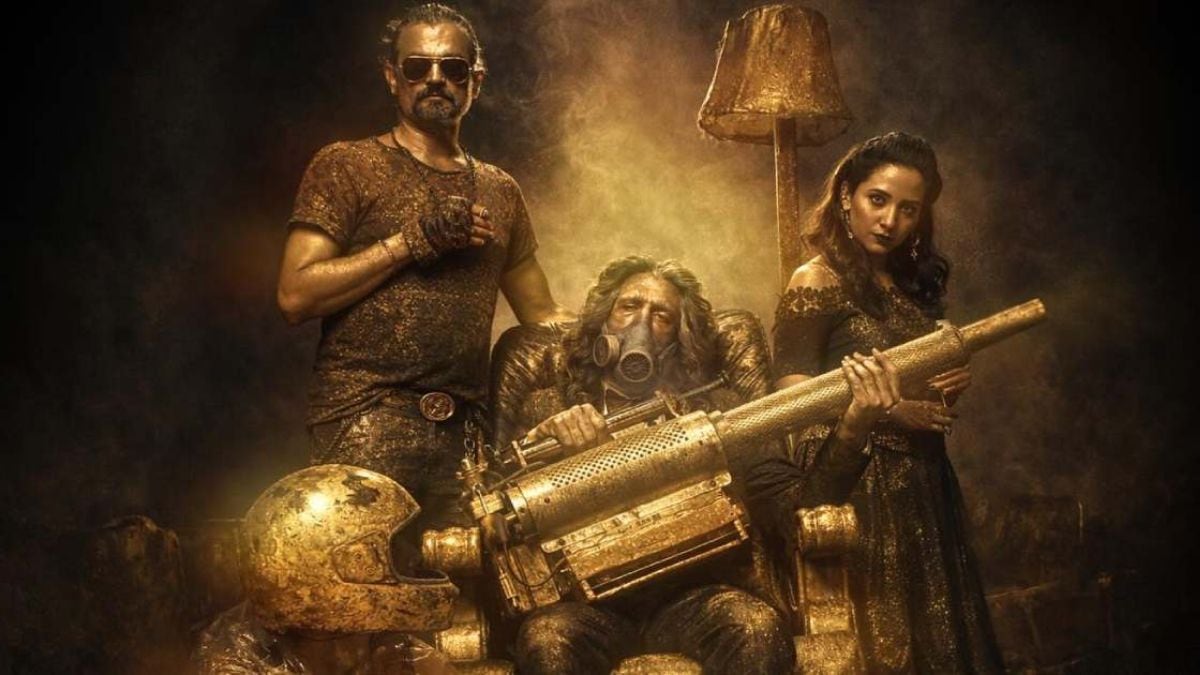
Promo poster for Mayasabha: The Hall of Illusion.
IN A FAIR WORLD someone who made Tumbbad, a fantastical film on greed, wouldn’t have to wait nearly a decade to make his next feature. In a fair world, the filmmaker wouldn’t have several projects on the back burner, battling uncertain fate. But such a world doesn’t exist, and Rahi Anil Barve is not just aware of this; he is subjected to it and through his films, he has made an art out of it. His sophomore film is posited in a similar universe of avarice.
There are more similarities. Like Tumbbad Mayasabha: The Hall of Illusion is a startlingly original film with its own language and worldbuilding, and like the 2018 outing, greed is placed at the centre both as a site of seduction and the reason for undoing. Barve also uses the emotion as a scalpel to instigate the human heart and reveal it. The result is a fascinating film that becomes increasingly indulgent across its runtime but offers enough merit to signal that most of it is earned.
Stream the latest films and shows with OTTplay's Power Play monthly pack, for only Rs 149.
Mayasabha is set in a rundown theatre. The owner is a man called Parmeshwar Kumar (a triumphant Jaaved Jaaferi), a gas-mask-wearing, temperamental man living in the present but held hostage by the past. Once upon a time, he was a successful film producer, but today he languishes in memory. The eeriness of the space makes it only easier. Parmeshwar lives in a labyrinthine movie theatre that is shrouded in cobwebs and memories. Years ago, his wife, also an actress, had left him for someone else, and since then, he imprisoned himself and dunked himself in self-pity.
ALSO READ | Is Boogie Woogie 2 on the cards? Jaaved Jaaferi reveals
The other occupant is Vasu (a terrific Mohammad Samad), his young son who, unlike his father, is aware of a world outside but is equally fearful. He wears a helmet indoors, which starts to make sense when Parmeshwar throws violent fits of anger, only to hug his son the next minute. When Vasu invites two of his friends, the lulled momentum of the place shifts.
Ravrana (Deepak Damle) and his sister Zeenat (Veena Jamkar), both dubious in their motives, are the guests. It becomes clear fairly early that they have set their sights on something else. Years back, there were rumours about Parmeshwar hiding 40 kg of gold in that coliseum; as the siblings’ eyes dart across the place and Zeenat tries flirting with Parmeshwar, it becomes difficult to guess the reason for their arrival.
Despite the sparseness of the characters (only four of them remain), Mayasabha commits itself to opulence. It is the setting: a rundown theatre where a broken chandelier is stuffed inside a table, where an old Rolls-Royce is gathering dust in neglect, where each room builds into another, where illusion is the only reality because what is real is no longer clear.
There is opulence even in the feelings. Written by Barve, Mayasabha is equally committed to the bigness — to that one big romantic love capable of upending someone forever, to the big parental love, conflicting in its extremes, to the big love of a child unable to understand his parent and loving him despite, and because of it. And then there is the engulfing lust for materialism that will stop at nothing.
It is no less ironic that Barve chooses to inspect the barest of human emotions through the lens of excess. As an offshoot, while Mayasabha retains intrigue, it also tends to get too consumed by the setting. The feature's theatrical language — amplified by the score — ends up muffling the filmmaker's voice and the premise's potency.
For instance, it is tempting to see someone like Parmeshwar as a repository of allusions. Constantly troubled by the buzz of mosquitoes and preoccupied with fumigating the place, the character could be anyone one wants it to be. He is a man with an incurable broken heart, an unequivocal tragedy. But he could also be one of the many faceless people (perhaps from the film industry itself) left behind in the big strides of modernity. Although abandoned, they keep living, if only in their heads, addicted to the stories they were once part of. His constant desire to tidy the place despite the piling squalor hints at the purity of his obsession. There is a line in the film when a character says that people like Parmeshwar are only remembered when they are dead.
But Mayasabha’s fixation with the superfluous also interrupts making these readings. There are other niggling moments: a character like Zeenat is written with the broadest of strokes; her intent is so blatant. And, Jamkar’s turn is too on the face. Despite it all, Mayasabha keeps swinging for the fences. It might not always land, but the film, much like his God-complexed protagonist, refuses to go gently into the night. And sometimes, only this matters.
Share