Home » Features » Roshan Mathew & The Discipline Of Subtlety
Features

Roshan Mathew & The Discipline Of Subtlety

From raw, outward anger to carefully contained longing, Mathew's performances suggest an actor who is steadily peeling back layers and seems more curious about inner conflict than outward flourishing.

Neelima+Menon
Feb 19, 2026
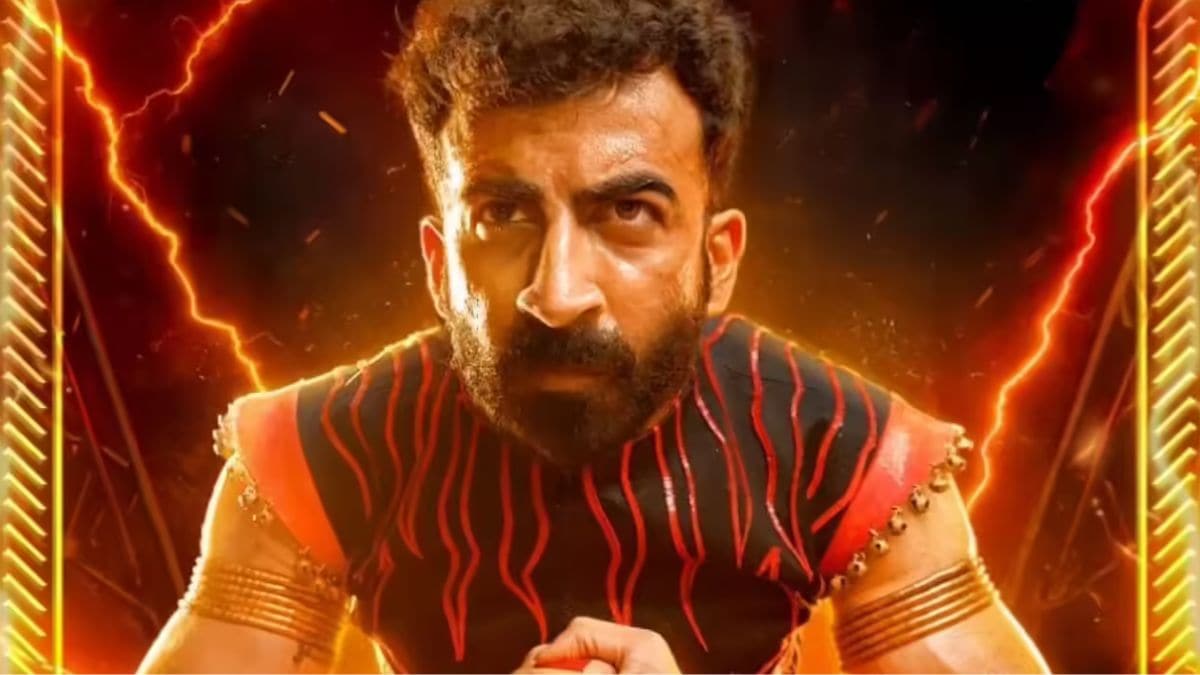
Roshan Mathew in the promo poster for Chatha Pacha.
IN Advaith Nayar’s Chatha Pacha: The Ring of Rowdies after his victory, Savio (Arjun Asokan) launches himself toward the rousing crowd, arms flung wide, body still vibrating from the fight he has just won. He screams, waves, and performs his triumph until the camera breaks away to an imposing figure in a checked shirt. His brown eyes seem to size up the room in an instant, even as his twirling moustache announces both swagger and intent. And then a loud, deliberate whistle follows. Vetri had entered the arena! But what makes the moment land with such force is not just the staging, but the actor inhabiting it. For Roshan Mathew, whose career has been shaped by understatement and by characters who fold into their environments rather than dominate them, this was a heightened cinematic bravado. For once, he was not a character who was quietly observed but one designed to be witnessed. Vetri here was a promise of conflict, of spectacle, of a narrative about to tilt. Undoubtedly, it stands as perhaps his most rousing embrace of cinema in its loudest, most unapologetic form. Chatha Pacha review: Roshan Mathew, Arjun Ashokan wrestling drama settles for a mid-card bout than aim for the title Most importantly, this was a moment he had to sell. And he does! Not long ago, the very same actor had stumbled while attempting a similar flip in Vysakh’s Night Drive where his character is afforded a starry build-up and a dramatic reveal, only for the moment to land with an unexpected thud. Though the mechanics were all in place, Roshan simply couldn’t summon the kind of cinematic electricity that the scene demanded.
That makes this entrance all the more significant. Here, the swagger feels earned. That way, this moment functions less as a one-off high and more as a marker of evolution. Perhaps an indicator that Roshan Mathew is now ready to bend, stretch, and adapt himself across genres without losing conviction.The beginning and after His debut, however, was something of a damp squib, a blink-and-you-miss-it appearance in Adi Kapyare Kootamani followed by a far more troubling role as a rapist in the Mammootty–Nayanthara headlined Puthiya Niyamam (2016). Neither part offered much room for nuance or visibility, leaving little indication of the actor he would eventually become. But then, ironically, it was in that very same year that Roshan found his first moment of reckoning. In Ganesh Raj’s Aanandam, a saccharine campus rom-com populated largely by newcomers, set in an engineering college and brimming with youthful chaos, Roshan, a trained theatre actor, managed to anchor himself within the noise. He played Gautham, a young man trying a little too hard to appear unfazed, to play it cool, especially in front of his girlfriend. It was a performance built on small, recognisable gestures rather than grand strokes.
It also helped that Roshan arrived at a moment when Malayalam cinema itself was in transition, opening its doors wider to fresh faces, unconventional casting, and a renewed commitment to realism. This was a landscape more forgiving of vulnerability than swagger, and for Roshan, whose strengths lay in restraint and emotional transparency, the timing could not have been more fortuitous. And then Geethu Mohandas’s Moothon (2019) happened.
Set against the quiet, insular rhythms of Lakshadweep, Roshan Mathew played Ameer, a mute man who falls helplessly, almost recklessly, in love with Akbar (Nivin Pauly), in a community where such desire was considered forbidden. Here, he communicates through a stillness that borders on the devotional, a Christ-like aura, and a gaze so tender that it even makes the otherwise serious Akbar blush. As Ameer, Roshan seemed to age overnight, from a boy into a man. The performance carried the accumulated weight of longing, grief, and emotional vulnerability, leaving us with a lingering ache. “At first, we had to get over the fact that we were two people who never acted together. Then it was the question of two straight guys playing gay characters, which requires a certain amount of comfort,” the actor had told this writer in an earlier interview. This was the kind of role that doesn’t just test an actor’s range but quietly recalibrates how he is perceived by filmmakers, audiences, and perhaps most decisively, by the actor himself.Since then, whether by choice or compulsion, the actor has largely been part of films that astutely tapped into his strengths (Night Drive being the notable exception). Be it the sinister loverboy in Kappela (2020) the unemployed husband in Choked (2020), the anxious young man searching for his missing fiancée in C U Soon (2020), or the amorous boyfriend eager to play out his fantasies in Aanum Pennum (2021), Roshan has rarely felt miscast. He slips into these roles with an ease that suggests an intuitive understanding of men on the margins, emotionally tentative, morally conflicted, and quietly intense. ALSO READ | Roshan Mathew: I keep pushing my co-actors to collaborate as much as possible
Also, his seamless foray into Bollywood with Choked (2020) was proof of his adaptability. His face and body language, often reminiscent of a young Naseeruddin Shah, did not look out of place in any geography, thereby reinforcing the sense that Roshan Mathew belongs to a cinema that travels easily across languages and spaces. Take Zulfi, who does odd jobs for a living in Darlings (2022); it’s easy to believe that he has spent his entire life in a Mumbai chawl. And the scene in which he confides that he is in love with Shamshu (Shefali Shah) carries a disarming, almost naïve sweetness.Casting against comfort Actors often speak of their attraction to antagonist roles, where the moral ambiguity allows them greater freedom to explore their range. Though not entirely successful, Roshan does explore this terrain in Sreejith N’s Oru Thekkan Thallu Case (2022) which is set in a coastal village where two men engage in a petty, almost silly battle of egos. His Podiyan Pillai is deliberately unpleasant and steeped in entitlement, but then one could see the actor struggling to locate fresh variations within the character. Beyond a constant undercurrent of simmering anger, the performance rarely discovers new emotional registers. While Prasana Vithanage’s Paradise (2023), which pivots around an Indian couple celebrating their anniversary in Sri Lanka, aligns more closely with Roshan’s strengths. At the outset, Kesav appears to be a sorted, dependable young man, deeply committed to his wife (Darshana Rajendran). But as the narrative unfolds, certain situations expose the fissures within him and within the relationship itself. Roshan inhabits this moral grey with quiet nuance, allowing the character’s entitlement, insecurity, and affection to coexist without forcing easy judgments. Roshan Mathew on Paradise: ‘Conveying the subtleties of Kesav was a challenge’
Two of his career-best roles that came in 2025 — CPO Dinanath in Shahi Kabir’s Ronth and the media professional Anish in Prashant Vijay’s Ithiri Neram, couldn’t be more diametrically opposed, and that contrast itself speaks volumes about Roshan Mathew’s evolution as an actor. Dinanath is young, idealistic, and painfully ill-equipped to make peace with the rot he encounters within the system. Anish, on the other hand, is much-married, and quietly haunted, grappling with the aching remnants of a past affair that refuses to loosen its hold. Roshan Mathew on Ronth: There was a beautiful creative collaboration on the set and that is because…
In Ronth Roshan lets helplessness and anger spill out with an almost abrasive rawness as the frustration sits close to the skin, erupting before it can be reasoned away. While in Ithiri Neram, the struggle is internalised; Anish is constantly policing his own emotions, trying to keep desire, guilt, and responsibility in careful balance as he is forced to choose between love and duty. Especially as Anish, Roshan walks a treacherous emotional tightrope, and he does so with remarkable control, never tipping into melodrama, never diluting the ache. And it’s in these restrained, conflicted spaces that he truly excels.
Though one can’t say this with certainty, after Chatha Pacha Roshan Mathew does seem to have cracked open a new layer in his craft, one that could well introduce fresh turns in his career and choices. Even otherwise, his trajectory so far reveals an actor evolving quietly, finding strength in the depth and honesty of each transformation. And at this point, that alone feels like half the battle won.

Stream the latest Malayalam, Tamil, Telugu and Kannada releases, with OTTplay Premium's Power Play monthly pack, for only Rs 149.

More of Roshan Mathew here on OTTplay!
Share
return(
)